Showing posts with label Tau Crisis Teams. Show all posts

Thursday, 13 April 2023

Welcome Back Commander

--XV8-Battlesuit-status: active--


--Ident passcode accepted. Welcome back, Shas'O Da'Anuk--


--Fusion reactor: online--


--Auxiliary systems: online--


--Sensors: online--


--Communications: online--


--Jetpack and maneuvering jets: online--


--Command and control systems: online. Synching with main command data network--


--Weapon - plasma rifle - input received. Status: online--


--Weapon - fusion blaster - input received. Status: online--


--Weapon - missile pod - input received. Status: online--


--Running final systems check. All systems online and functioning optimally. Tau'va-- 


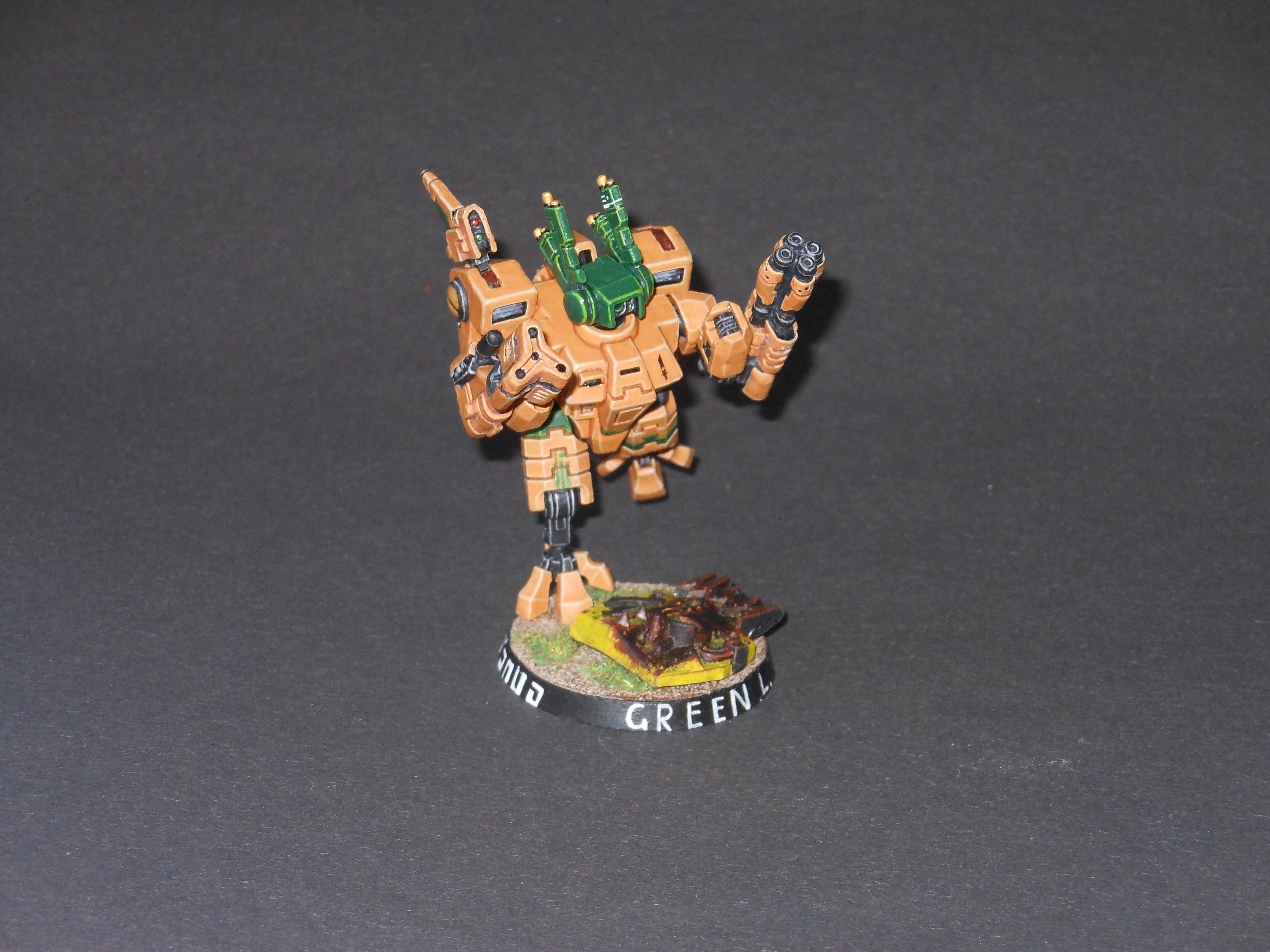
Here he is, Shas'O'T'au Kais'ka'Eoro'Da'Anuk, Commander Kakapo (or Commander Nightwing if anyone from the Imperium is asking) himself, in the flesh. 


For much of my time with 40k my Tau army did not really have a commander as such. Partially this was due to the HQ section being by a fair margin the least crowded and interesting part of the Tau army. In an army of giant hover tanks bristling with laser-guided cruise missiles and electromagnetic death cannons, power-armoured commandos with invisibility devices and tooled-up infantry troops with badass-looking helmets, it can be hard to get excited over.. a Crisis Suit with a better stat-line and the extraterrestrial love-child of Gandalf and Jacinda Ardern. Don't get me wrong here, the love-child of Gandalf and Jacinda Ardern is a really cool concept that I am 100% down for, but it just lacks a certain visceral cinematic oomph that the giant hover tanks and invisibility commandos possess in abundance. 


But mostly it was because for a very long time I just did not get the HQ section in Warhammer 40,000 on a fundamental level. Before getting into Tabletop games my main experience with strategy battles was from RTS computer games, especially Starcraft and especially the various games in the Command & Conquer franchise, all of which put me the commander as a faceless amorphous god-like presence directing the battle from an omniscient vantage point far far away from the actual fighting. Whenever games like Starcraft handed me a special unique character unit, I would invariably leave them safely tucked into an out-of-the-way corner of my impregnable stronghold surrounded by a sea of defensive weapon emplacements while the actual combat was carried out entirely by wave after wave of regular troops. 


Given that tabletop wargames like Warhammer 40,000 appeared to be equivalent to analogue RTS video games to my 8 year old self, the logical conclusion I came to was that when playing this new 40k thing I would continue to be an invisible god-like presence commanding my little metal minions from somewhere else far far away from the battlefield on the tabletop. After all, it's a sci-fi game set in the future. The future has technology. In a world with long-range real time communications technology, why would you ever put the army's commander in harm's way when they can direct everything from a nice safe reinforced underground bunker thousands of kilometres away from the dangerous fighting? 


Before you comment with a lecture on how real-life military command and control structures work and how the kinds of high-end commanders directing everything from a reinforced underground bunker thousands of kilometres away from the battlefield are at a higher tier of the chain of command than what most 40k HQ units are actually modeling, remember that I was 8 years old at the time. Present Day Adult Me understands the difference between a Colonel directing a battalion on the ground and a Field Marshal directing a Front from a command centre where they can see the big picture across the entire theatre. 8-year-old Me Raised On C&C did not, and it honestly would have gone straight over my head if you had tried explaining it to me. 


Anyway, the upshot of this is that for a very long time I just could not fully understand the point of the HQ section in 40k armies, outside of Tyranids where it made perfect sense for the Hive Tyrant as a big final boss Hive Queen monster, and as a hypothetical place for lone special forces operatives with a gun that killed infantry instantly but did nothing to vehicles and hand-placed bombs that blew up buildings instantly (Command & Conquer background remember). And named Hero units that sit in the corner while the rest of the army fights because I lose the level if they die. The idea that they actually represented me as a player character in the universe was a completely alien concept. 


This meant that for some years my Tau army just did not have an HQ unit of any kind at all. When I finally did add one it was mostly because the game rules forced me to, and I went with an Ethereal because by this point my No Battlesuits policy had become a thing. That was how it was until around 2009 or so, when I noticed that the army rules in Codex: Tau Empire also forced me to take a Crisis Suit Commander. That finally drove me to go out and procure this guy: 


This was the first Shas'O to lead the army, and was the first HQ unit that I ever put real serious effort into. Having purchased him in 2009 he came as part of the shiny new Crisis Suit Commander box, which also included a blister of shiny new metal Special Issue gubbins and variant heads. The alternate head pieces never really caught on with me, for various reasons (one was too big and the other was too knobbly), but the Special Issue gear was another matter entirely. I had loved the look of the awesome metal Special Issue guns from the moment I first saw them advertised in White Dwarf, and the Special Issue support systems weren't too far behind them. So they were immediately glued into place without hesitation. There was also an element of convenience at work here - I still hadn't fully comprehended the subtleties of Battlesuit equipment combinations yet, so just loading the Commander down with all of the Special Issue guns and support systems he could carry was an excellent eliminator of choice that let me side-step the whole question of how to outfit my new Battlesuit; just pick the shiny wild fun experimental guns and call it a day. 


The only real question that remained was which fancy metal support system to go with, and I opted for the Command And Control Node largely because it was the only one that made sense to me. The tactics of Reserves were still too arcane for my primitive teenage brain to really grasp, and I wasn't particularly enthusiastic about a device that just sent information off the table, but an advanced AI-assisted transmission system that efficiently beamed my orders into a nice simple Leadership boost for everyone within 12" was much easier to comprehend. By the time I noticed that the Command And Control Node only affected Target Priority Tests which are not a thing in the 5th edition rules I was following at the time, it was already glued on and I did not really care too much. In the end it was a moot point anyway since there never ended up being anyone within 12" of the Commander in any of the three games I managed to play with the older army. But it was an AI-assisted communications system, and that's always going to be a handy thing for a commander to have regardless of what some stupid rulebook says. 


I was once asked if I ever ran a Super Prototype battlesuit with every single Special Issue wargear option piled onto the one model, but the website where it was asked burned down, so I never got to answer them in time there. But to answer the question, no I never did, but I did come close. For all the games this guy was used he was loaded down with as many extra Special Issue wargear items as I could get away with not modeling. Irridium armour was the first addon thrown in, because hey awesome a 2+ armour save like the Terminators get and the different hue of sandy ochre could comfortably pass as a new formula of armour plates (it helped that my 2+ save native Broadsides also had the same colour), but I also ended up throwing in a Stimulant Injector too because a medical healing juice dispenser seemed like the sort of small discrete thing that could easily be tucked into the interior compartment of a battlesuit without leaving any sign on the outside, and the Feel No Pain rule was nice to have too. Everything else either ate up a support system hardpoint - and I was all out of those - or required some extensive converting and/or kitbashing that I did not feel confident about, and at the time I was cautious around invisible wargear items. 
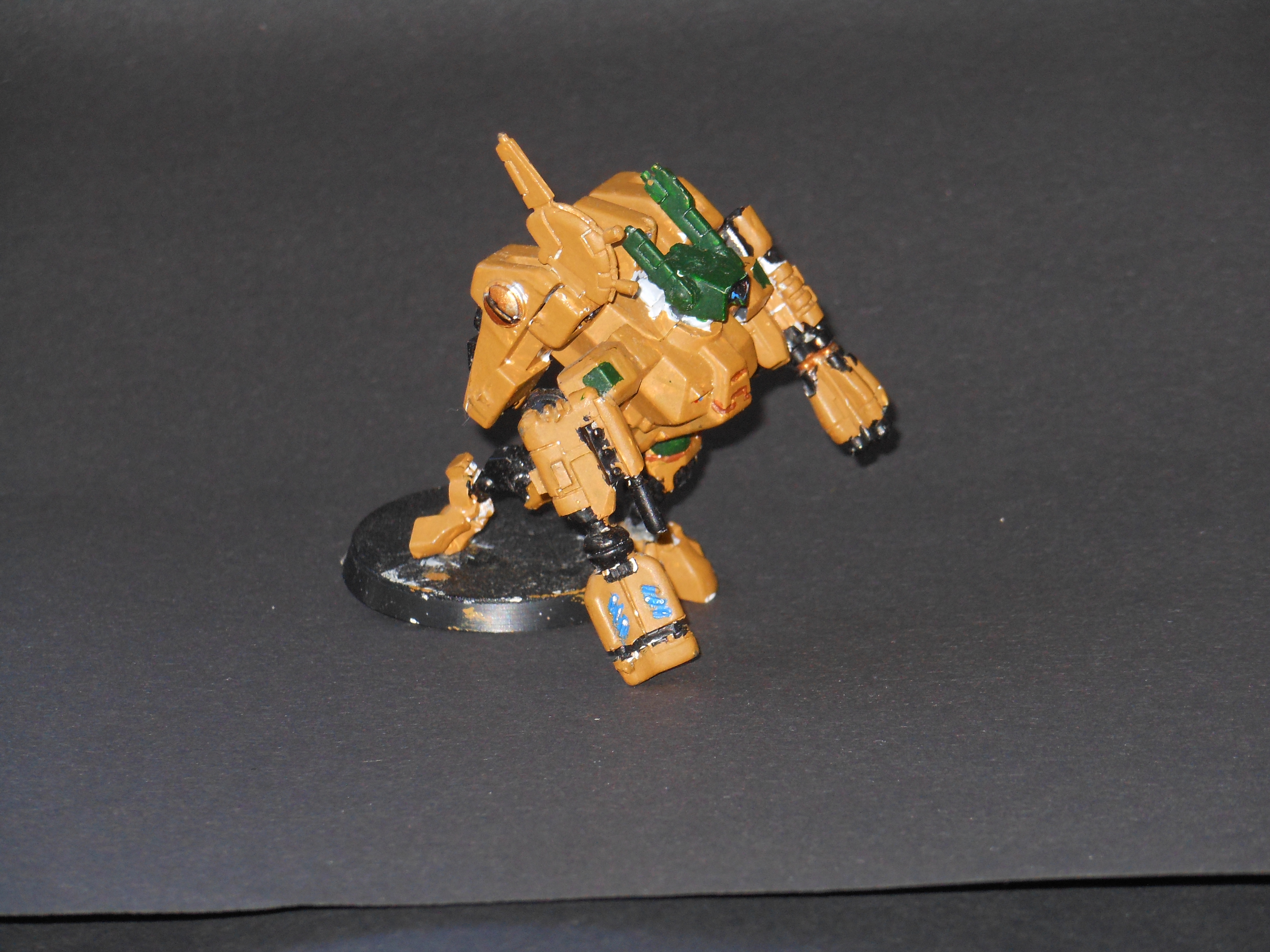


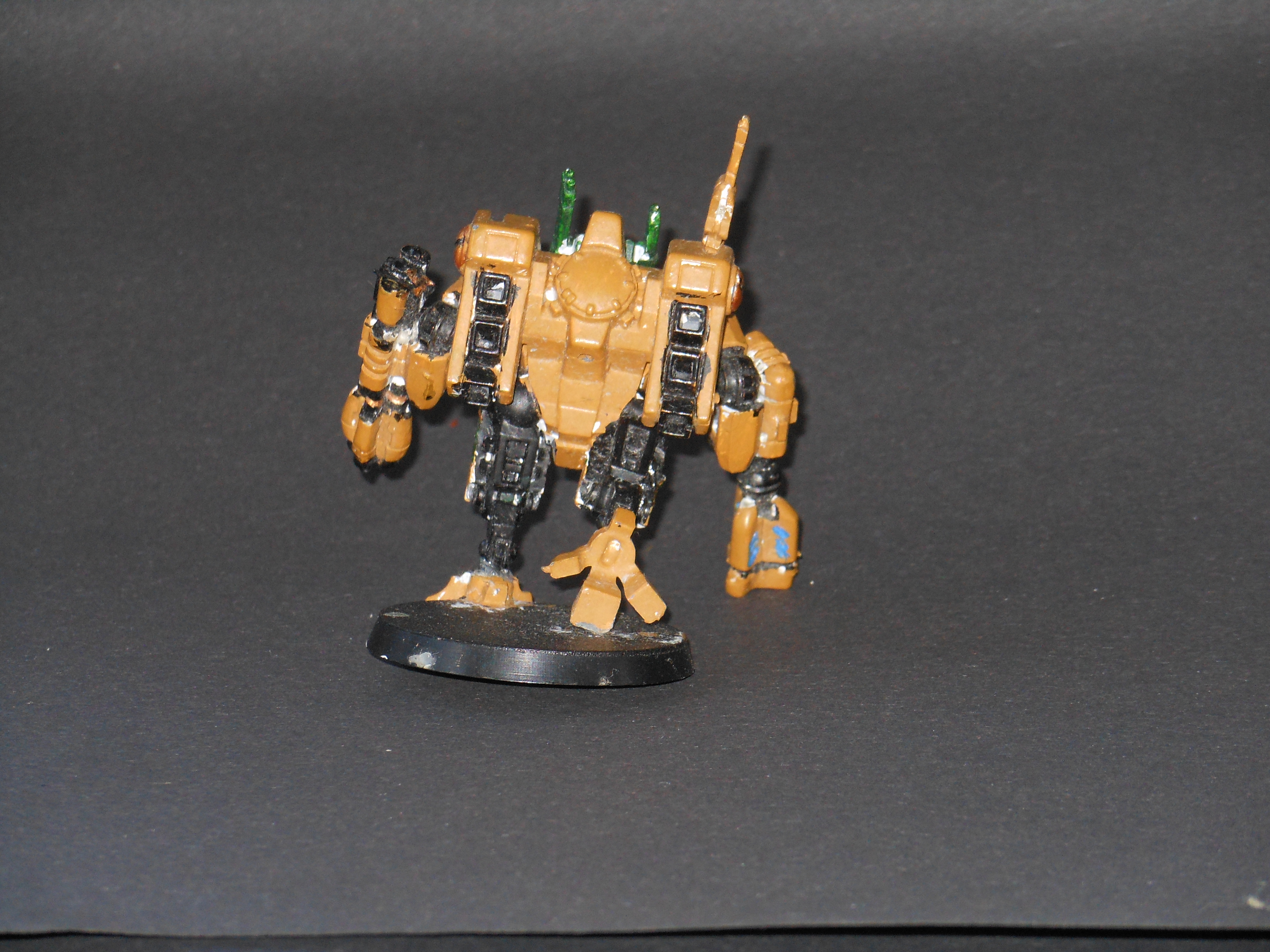
Aside from the weapons loadout, the first thing you might have noticed was the pose. When I was putting the model together I had the wild idea to model him literally walking off his base, a concept that I immediately thought was awesome and wild and meta and hadn't been done before and it was everything my brain had ever wanted to think about. 


Now, this was about a year or two before we covered the concept of a centre of gravity in school, so at no point did it ever occur to me what sort of effect putting the bulk of the model away from the base would have on the model's balance and ability to stand upright. After all, this thing was mostly plastic, and plastic is really light right? How bad could it possibly be? Again, the fact that the model had two very heavy metal guns shifted even further forward never registered once with me. What did register was that it looked so cool and meta that the model was literally stepping off its base and straight into battle. It was almost like something out of Toy Story


The result is evident from the pictures, and the model is incapable of standing upright on its own. There was a tactical rock - not a plastic one or anything, a real actual rock that I found outside - that was applied to the base as a counterweight and mostly solved the problem, but it was never permanently glued on and I have no idea where it went. 


The other noteworthy thing about this model is that it is the first model I've documented on here that belongs to the White Period of my Tau army. In 2006 I went home from one of the local GW stores with my first ever White Dwarf magazine, Issue #313(AU) covering the release of the Dwarf army book for 6th edition Warhammer. But what it also featured was a showcase of Australian model hobbyist Sebastian Stuart's legendary Tau army, and that very quickly became the biggest influence on my own Tau project. 


A lot of Sebastian's modeling techniques and conversions were beyond my means and hobby skills at the time, but one innovation that I readily adopted was the white undercoat. Sebastian's main Tau army (he has two) uses a colour scheme based off the GW Studio Tau army, and features a sandy ochre tone as its primary colour. Unlike the GW Studio Tau army, Sebastian's Tau were painted with a white undercoat rather than a black one, and the smooth even tone on the models impressed me so much that I immediately adopted a white undercoat for all my future Tau models. 


At the time I was very pleased with the results, which produced a sandy ochre colour that was much less orange and much more sandy looking, which is what I wanted at the time, though doubtless the application of brand new Tausept Ochre Citadel Foundation paint helped there. It quickly became my new standard, which persisted all the way until 2011 when I started shifting back to black undercoats for my Battlefleet Gothic ships because it was easier to just drybrush white over black than it was to wash black over white and then drybrush white over that. After that I learnt how shading and highlighting colours actually worked, and went back to black undercoats for everything for organic shading so I could avoid using washes. This left my white undercoats in a similar place to swing-wings on aircraft - an ingenious solution to the engineering challenges of the time that worked well, but was ultimately left behind once simpler technological alternatives caught up. 


Of course what did carry on was my scheme of colour-coded battlesuit accents. I came up with the concept of colour-coding my battlesuit teams based on battlefield role not long before I got this model, and it represents the first application of the scheme. Aside from some Broadsides that arrived shortly after this guy did, it was also the only application of the scheme until new Battlesuits started going into production in 2020. 


This Commander served me well during the brushfire wars of 2010 that represent the only 3 games when my old Tau army was ever deployed in anger, and was still in command in 2013 when the identity of my Tau army finally began to take shape from participating in online forum RP threads, which gave the backstory process a much needed shot in the arm by forcing me to actually think about what kind of character the Commander I was RPing was. The RP threads in turn combined with the limited tabletop history I had (with some embellishments) and some personal life details to form the nucleus of Da'Anuk's identity as a Shas'O with a solid decent if unspectacular performance record relegated to backwater postings along with his cadre after a particularly gruesome defeat, only to end up in the right place at the right time to serve with distinction in a key victory that put him and his forces back on the map just as the 3rd Sphere kicked off, getting his cadre rebuilt with Guards status and sent into a new wave of expansion and adventure that continues to the present. 


It is that era that is reflected in this new model. 
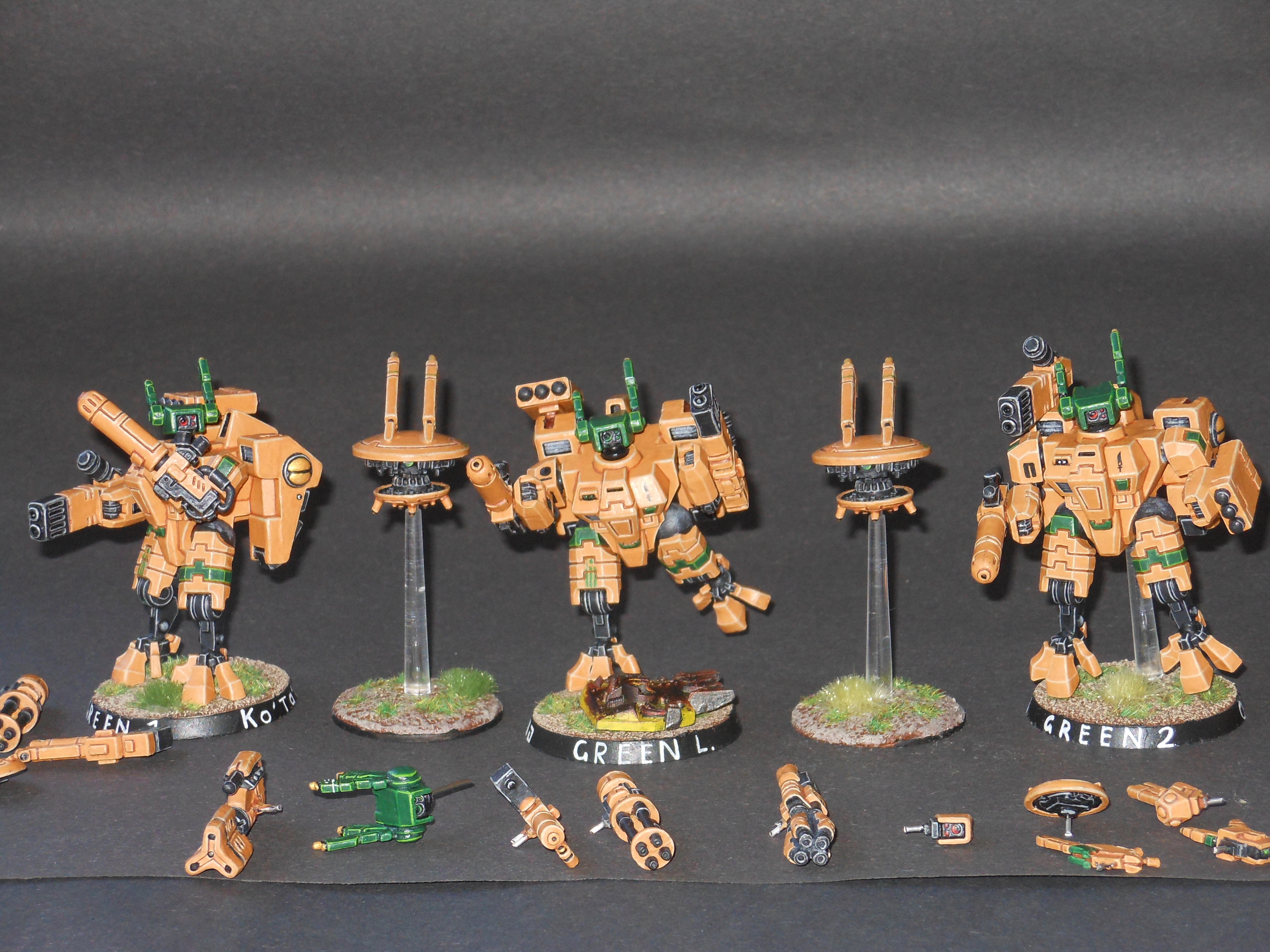


There are a lot of changes that have been done for this new incarnation of Da'Anuk. Perhaps the most immediately obvious one is that he now has some friends. In the past I never really bothered with Bodyguard teams, partially because of my generally cold attitude towards battlesuits on principle but also because for a long time I was very strongly influenced by online tactica articles about 40k. Now, the thing about online tactica articles for all tabletop wargames is that apart from a few exceptions the vast overwhelming majority of them are written by sour prudes who hate fun, which in the case of the ones for Tau in 40k meant that Bodyguard teams were usually dismissed as not worth it because of their points cost. But at the time I did not know that the tactica articles I was reading were written by fun-hating sour prudes, and points costs were something I never paid any attention to even when they were being talked about, so I tragically assumed that Bodyguard teams should be avoided because they were just not useful or interesting. 


This changed after 2013 or so when I began to grow more aware of just how much the online Warhammer community is systemically populated by Roald Dahl Children's Book Authority Figures, and how much those RDCBAFs colour and influence the content of a lot of online tacticas, and consequently began to filter them out and start thinking more about the stuff I wanted to take rather than what the internet wanted me to take. This lead me to radically reevaluate the value of a Bodyguard team, because two badass right-hand warriors watching out for danger as personal guards is awesome, and by this point I was starting to get a little envious of the colourful diverse command squads everyone else got to take for their HQ commanders and a Command Team of a Shas'O, some bodyguards and a couple of drones felt like a nice equivalent. 


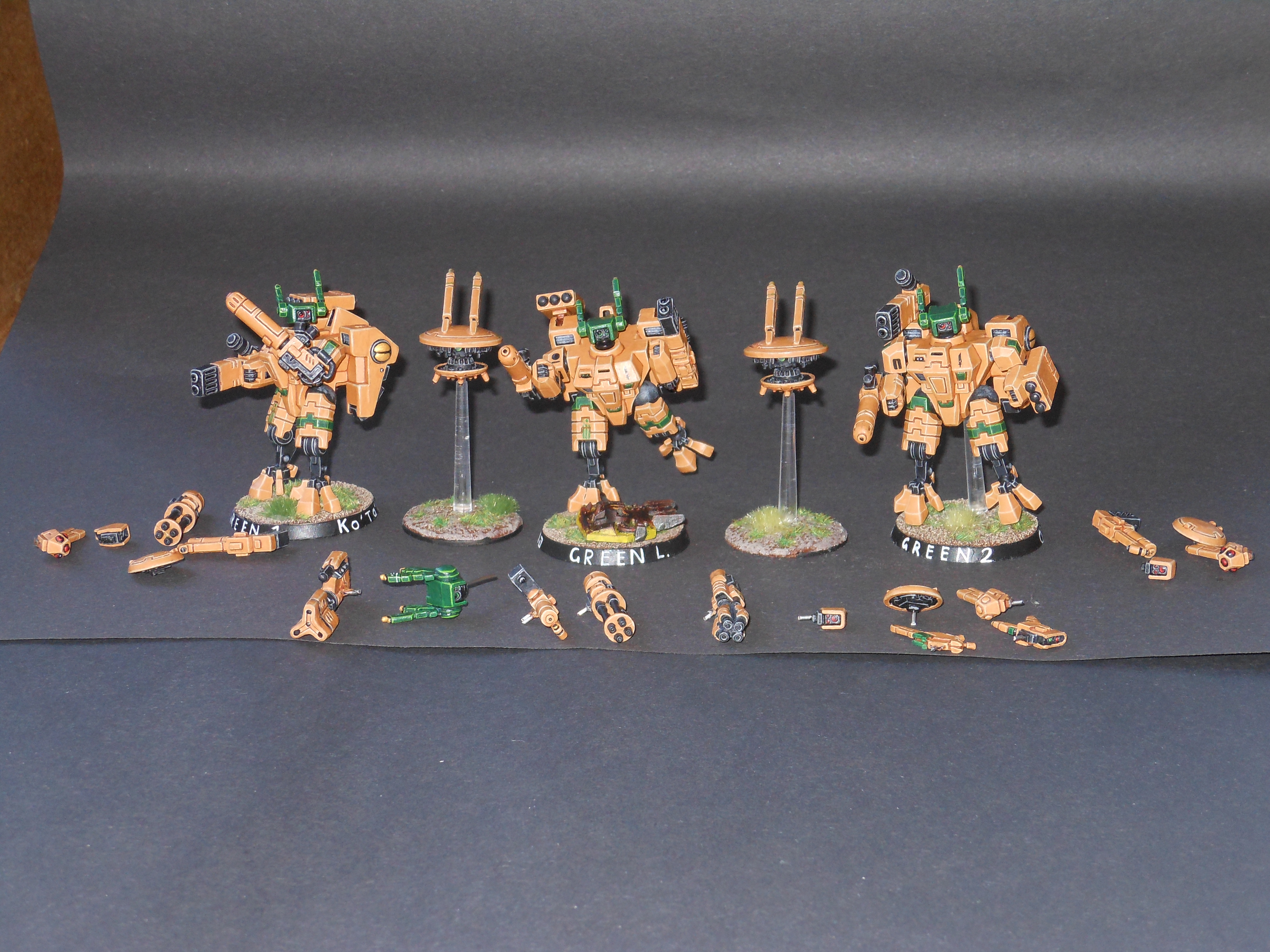
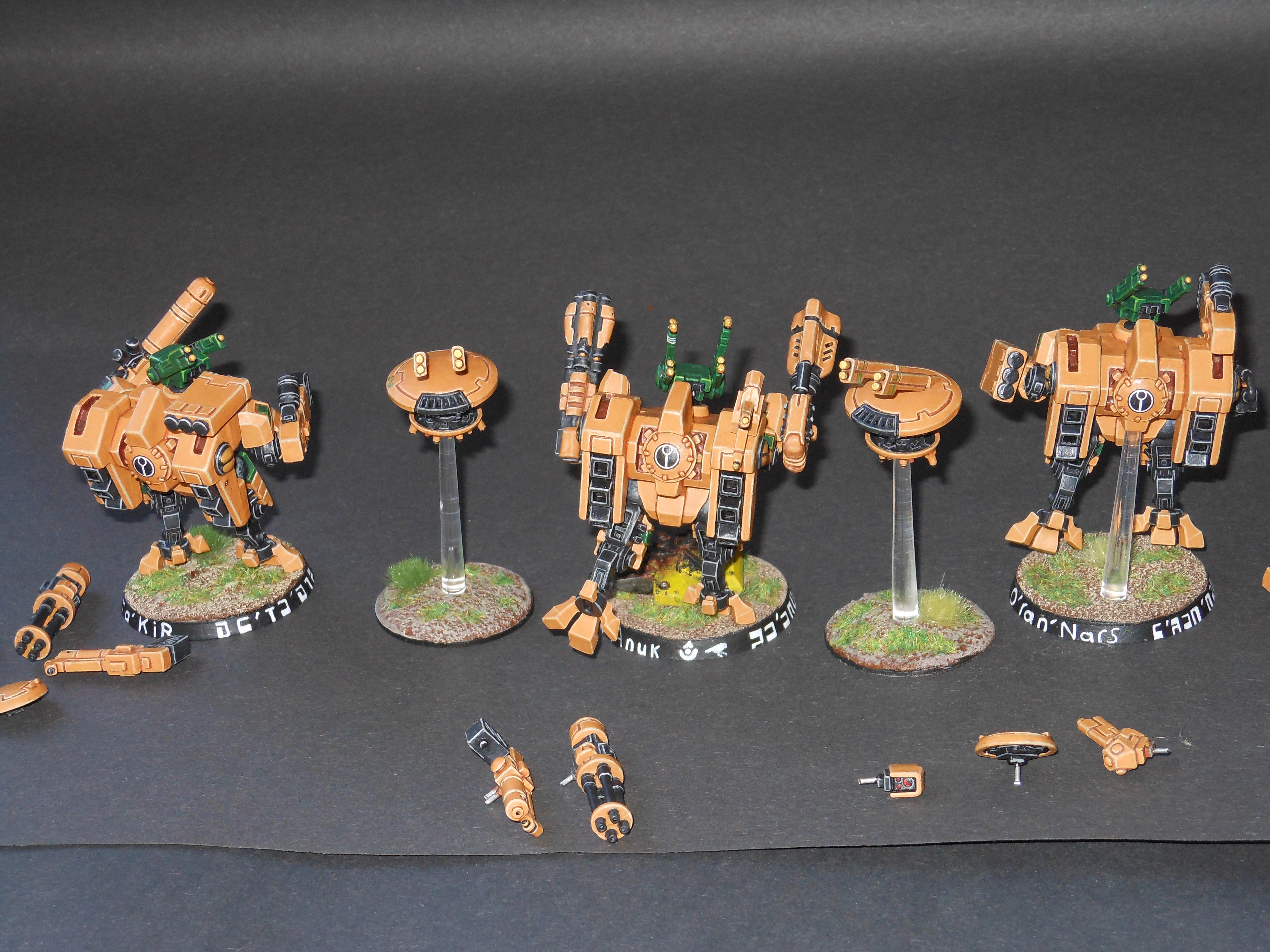
So when the time came I gleefully put together a pair of bodyguards that would accompany my shiny new commander in the vast bulk of games going forward. Ko'Ta'Kir is the senior of the two, being Da'Anuk's right hand XO and the team leader of the bodyguard detail. It was only just last year that I actually noticed the "One bodyguard may be upgraded to a bodyguard team leader for +15 points" part of the unit entry that I can recall with Mandela Effect precision was never actually written, but I went ahead with painting one up as the team leader and XO anyway, complete with a set of green ID stripes to make it harder for marksmen to single out the real commander, and to let her act on the table as an independent Shas'El if necessary. She is also a Freebie, being built from a lone XV8 sprue I got as part of a giffle prize one year, making her an unofficial leader of the Free Company element of the army. O'ran'Nars, the other bodyguard, is just a regular Crisis Suit box I purchased the hard way, but he was also to my knowledge one of the last single Crisis Suit boxes sold. 


The bodyguards are shown in their planned default loadout (though like the other Crisis Suits their hardpoints are magnetised), first devised around 2014. The original plan for the weapons load was as a foil to Da'Anuk's suite of Special Issue gear. While the commander ran around with all the fancy experimental guns, his bodyguards would sport a grounded sensible package of proven reliable weaponry to take down any threats to their charge. That meant fusion blasters for knocking out tanks (and big gribblies), plasma rifles for frying power armour, and missile pods because that was the other most practical and reliable 'gun' available, and Da'Anuk's airbursting fragmentation launcher was deemed enough for dealing with swarms of light infantry so flamers were unnecessary (I was also feeling a little insecure about the level of medium range firepower at my disposal). 


Then I pivoted completely towards using Codex: Tau almost exclusively, and needed to come up with an alternative loadout for the commander that did not make use of stuff invented for Codex: Tau Empire. Thinking about it, the Shas'O has Ballistic Skill 5, which is very good. That meant I needed to make the most of it, which in turn meant: 


- I definitely wanted a missile pod. That BS 5 is just too good not to use for long-distance shooting. 


- I also definitely wanted a fusion blaster. That BS 5 is just too good not to use for reliably knocking out big targets. 


- But what about close-range shooting at infantry? That BS 5 is just too good not to use for reliably hitting with an AP2 plasma rifle to pick off Space Marines. 


So it was decided. For games using Codex: Tau my Commander would sport a missile pod, a fusion blaster and a plasma ri- wait a minute... 


As well as accidentally replicating the same weapons load as the bodyguards I also looked through Imperial Armour Volume 3 and noticed that I had also accidentally replicated the exact same weapons load used by Crisis Teams in Epic. And that was all the sign I needed to run with it. 


As well as a pair of bodyguards, Da'Anuk has also picked up a pair of shiny new Shield Drones, which represent the first fully metal components to appear in the army with their gloriously pointy shield generators and supersized aerials. The one on the right, 042, is also technically one of the first 40k models I ever owned, being built with the metal Shield Drone parts that came with the Stealthsuit Shas'Vre I got on my first ever GW visit when I was 8 (mated here to a stray giffle prize drone chassis). Like the commander they're assigned to, they feature advanced green optics instead of the standard red optics used by the rank and file, a feature to mark them out as specifically part of this unit along with their green ID sept markings. "You remember when I said I was going to make all this army's drones one communal pool? Aye Laihd!" 


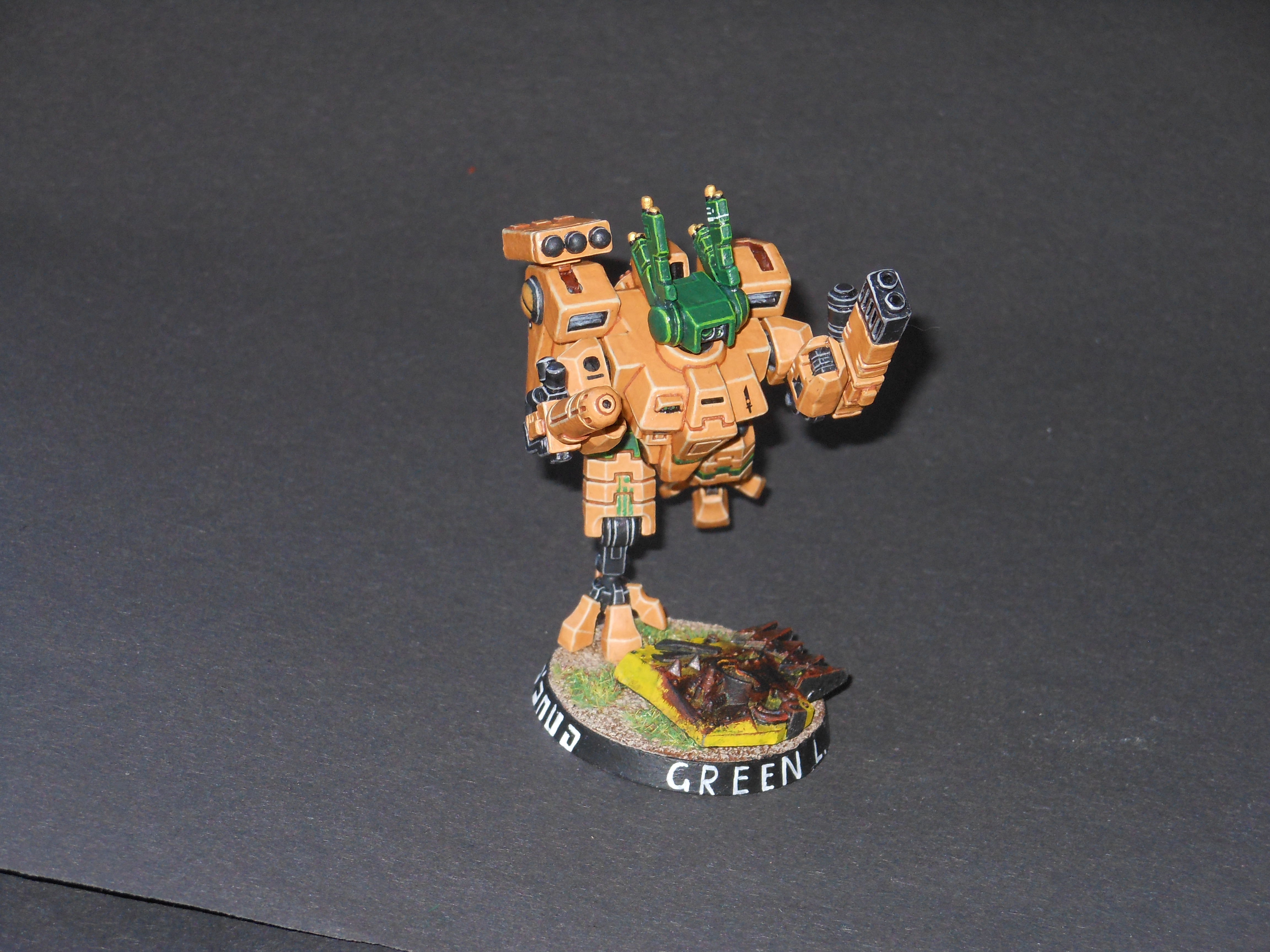
Da'Anuk himself has also had a few modeling upgrades. The posing problem has been fixed, using the simple workaroud of switching from 'model walking off the base' to 'model walking onto the base', which is only slightly less cool and meta while being much more stable. The arms have also been pointed upwards to keep the model's centre of gravity as central as possible when heavy weapon components are fitted - it occurred to me that keeping them pointed downward would have probably kept the centre of gravity central and closer to the base, but I also wanted a bit more of a break from the older pose and the upwards arms look more dynamic and less simian. 


His Crisis Suit is also different to the rest of those in the army thus far, because it is a different make - where all the other battlesuits so far have been 2006 resculpts, this one was a 2001 original sculpt. Having decided I wanted as authentic a 3rd edition model as I could get for the Shas'O, I looked around and was fortunate enough to find a 2001 era Crisis Suit box going on eBay for a reasonable price (by eBay standards at least). The box turned out to be rather squashed, but the models within it were in great shape, and I was amazed to discover just how much of a glow-up the 2001 sculpt is over the later versions. Compared to the 2006 version, there are a few areas that are more detailed - most notably the ankles, which are less defined on the 2006 version in return for also being less fragile - and crucially the 2001 sculpt features much higher casting quality, with more seamless joins between parts and none of the 'pits' of sunken plastic that appear around the neck and jetpack hardpoints on the 2006 models and are notoriously irritating to fill in with greenstuff. 


But most dramatic of all is that he now has a choice of battlesuit head. Ever since I first got into the Tau I have always loved and admired the more symmetrical head antennae that the Farsight model has, even when I never really got that into Farsight the character, and for many years I longed to have a commander model with the same aerials, but without the Farsight Enclave logos, because for many years I was never fully comfortable with the asymmetry of the regular Crisis Suit head aerials. A couple of years ago I received a box of (mostly) Tau bitz as a reward for helping my friend out with a school fair stall they were running, and among the bitz contained were a set of metal Farsight model pieces including the two head aerials and the shield generator - only the Dawn Blade arm was missing. There was also a spare 2001 vintage Crisis Suit head. Since there was not enough pieces to make a complete Farsight model using a spare battlesuit kit, I decided it was a good chance to realise my childhood dream of a Tau commander with (almost) symmetrical head aerials. The catch however was that by this time the regular asymmetric aerials had grown on me and I now actually liked them a lot too, especially their mounting hubs that were more discrete than the giant earmuff-like disks the Farsight aerials sprouted from. So in classic Kakapo fashion I of course deadlocked on the decision and painted both head variants up, leaving them pinned to plug into the battlesuit body as I see fit. The Enclave logos were paved over with greenstuff and PVA glue in the process to produce a more Empire loyal look. 


Speaking of pins, unlike all the other Crisis Suits Da'Anuk's hardpoints are pinned rather than magnetised. This is so that they can accommodate the weight of big heavy metal components like these. 


While I am largely committed to using Codex: Tau in games wherever humanly possible, I ended up with a few metal special issue guns in a bitz bundle I received a few years back so two of them got painted up along with some special issue support systems, at the insistence of the Old Guard generals who argued that you never quite know when you might be in need of an AI-guided cluster bomb launcher or a quick-firing particle beam and demanded that the new commander model retain full special issue wargear compatibility before they agreed to lobby for funding for it. There is also a considerable chance I may end up putting them to use in the occasional game of late 4th edition 40k, because I am aware of at least one friend who is almost as passionate about the 4th edition Tyranid codex as I am about the 3rd edition Tau one, and since I have very few serious reservations about later 4th edition I am perfectly happy to oblige any taste for games with the 4th edition Tyranid book by pairing it against its natural 4th edition Tau adversary. 


This also meant that the Positional Relay I got with the first commander also finally received a coat of paint, because now I am Smort enough to know how 40k Reserves work and why it is valuable to always be able to have the Reserve you want most available on a 2+. But I also painted up a spare Command And Control Node too (again, the Old Guard generals demanded it), allowing me to completely replicate the old commander loadout if I wish. 


Even the base has had an overhaul. From the start of this revamp I knew I wanted a nice chunk of opposing wreckage on the base, and the bitz bags I had won at GW holiday events left me 3 choices. The first was the frontal plate of a Blood Angels Dreadnought - this was very tempting, but in the end I decided to save it for later use as an objective. The second was half a Carnifex head, which very nearly ended up going on the base because Tyranids do feature quite prominently in the army's backstory where their first major victory after being rebuilt was against Tyranids in a big cityfight, but I ultimately opted against it because it was from the newer Ballfex design and I like my Tyranids to be of the more menacing 3rd edition 2001 flavour. The final option was what I believe is the face plate from an Ork walker - now this had potential! The haphazard nature of Ork stuff means that parts from later models can often pass for 2000s items without too much trouble, Orks also feature prominently in this army's backstory (not least through the Wurrshuv's Revenge campaign from Advanced Tau Tactica) and most imporantly of all my main two prospective opponents for 3rd edition 40k games both have Ork armies. Conveniently, they also both have Ork armies that feature a lot of yellow, so deciding on a colour scheme for the debris was easy too, so I dutifully painted it up in dark metal and bright yellow and then attacked it with brown, grey and black drybrushes to create a scorched burn effect that I am utterly delighted with. 


All in all, this leaves me in a very exciting place. The most exciting part is that I no longer have to paint any more Battlesuits! Not for a long, long, long time at least. There will be more in the future, but the infernal things are such a massive drain on my time and joy that they have now plummeted straight to the bottom of my painting que, past even horses. This is unlikely to make painting them any less of a chore, but it will ensure that I at least have a bunch of interesting stuff to play games with in the mean time. 


And on that note, it also leaves me with not just my first 1000 points of new Tau army, but in fact my first 1100 points. 


HQ 

Shas'O'T'au Kais'Ka'Eoro'Da'Anuk: Shas'O in XV8 Crisis Battlesuit with plasma rifle, missile pod, fusion blaster, hard-wired multi-tracker, hard-wired blacksun filter, hard-wired drone controller and 2 Shield Drones - 162 pts 

Green Team: 2 Shas'vre Bodyguards in XV8 Crisis Battlesuits with hard-wired target lock, plasma rifle, fusion blaster and missile pod, Bonded - 188 pts 

Elites 

Gold Team: Shas'vre in XV8 Crisis Battlesuit with hard-wired blacksun filter, plasma rifle, fusion blaster and missile pod, 2 Shas'ui in XV8 Crisis Battlesuits with flamer, plasma rifle and fusion blaster, Bonded - 223 pts 

Troops 

Fire Warrior Team Kais: Shas'ui with pulse rifle, markerlight, hard-wired multi-tracker, photon grenades and EMP grenades, 4 Shas'la with pulse carbines, photon grenades and EMP grenades, 7 Shas'la with pulse rifles, photon grenades and EMP grenades, Bonded - 205 pts 

Fire Warrior Team Lar: Shas'ui with pulse carbine, markerlight, hard-wired multi-tracker, photon grenades and EMP grenades, 2 Shas'la with pulse carbines, photon grenades and EMP grenades, 9 Shas'la with pulse rifles, photon grenades and EMP grenades, Bonded - 205 pts 

Fast Attack 

Gun Drone Squadron: 8 Gun Drones - 96 pts 

Provisions 

Laura's Roadside Inn Breakfast Order: 15 Big Kiwi Breakfasts, 15 Vegan Hash Brown Feasts, 30 Tropical Delight Smoothies - 10 pts 

Golden Bakery Special Order: 15 Sausage Rolls, 15 Vegetable Pies, 5 Red Powerade bottles, 5 Blue Powerade bottles, 5 Mango Green G-Force bottles, 20 1.5 Litre Pump water bottles - 4 pts

King Coral Takeaways Special Order: 2 $40 Fish and Chip specials with extra crabsticks and extra potato fritters, 1 $30 Fish and Chip special with extra crabsticks and extra potato fritters, 4 1.5 litre bottles of Vanilla Coke, 4 1.5 litre bottles of Coca-Cola, 5 1.5 litre bottles of L&P, 5 Lime Thick Boy Shakes, 5 Strawberry Thick Boy Shakes, 5 Vanilla Thick Boy Shakes -  6 pts 

Lone Star Dairy Purchase: 30 Large Chocolate Fish, 5 Strawberry Coconut Shakes, 5 Lime Coconut Shakes, 5 Passionfruit Coconut Shakes - 1 pt

TOTAL: 1,079 pts


It is also conveniently exactly the full transport complement of a single Orca Dropship (except for the 2 Sheild Drones, but they can be strapped down where the Ethereal normally sits). 


Having looked through the archived files of the very first photos I ever took as a kid (using the family's very first ever digital camera no less), tragically few group shots of the old army have survived to the present. I have very vivid memories of taking an earlier one, but this one here is the oldest group shot I can find. 
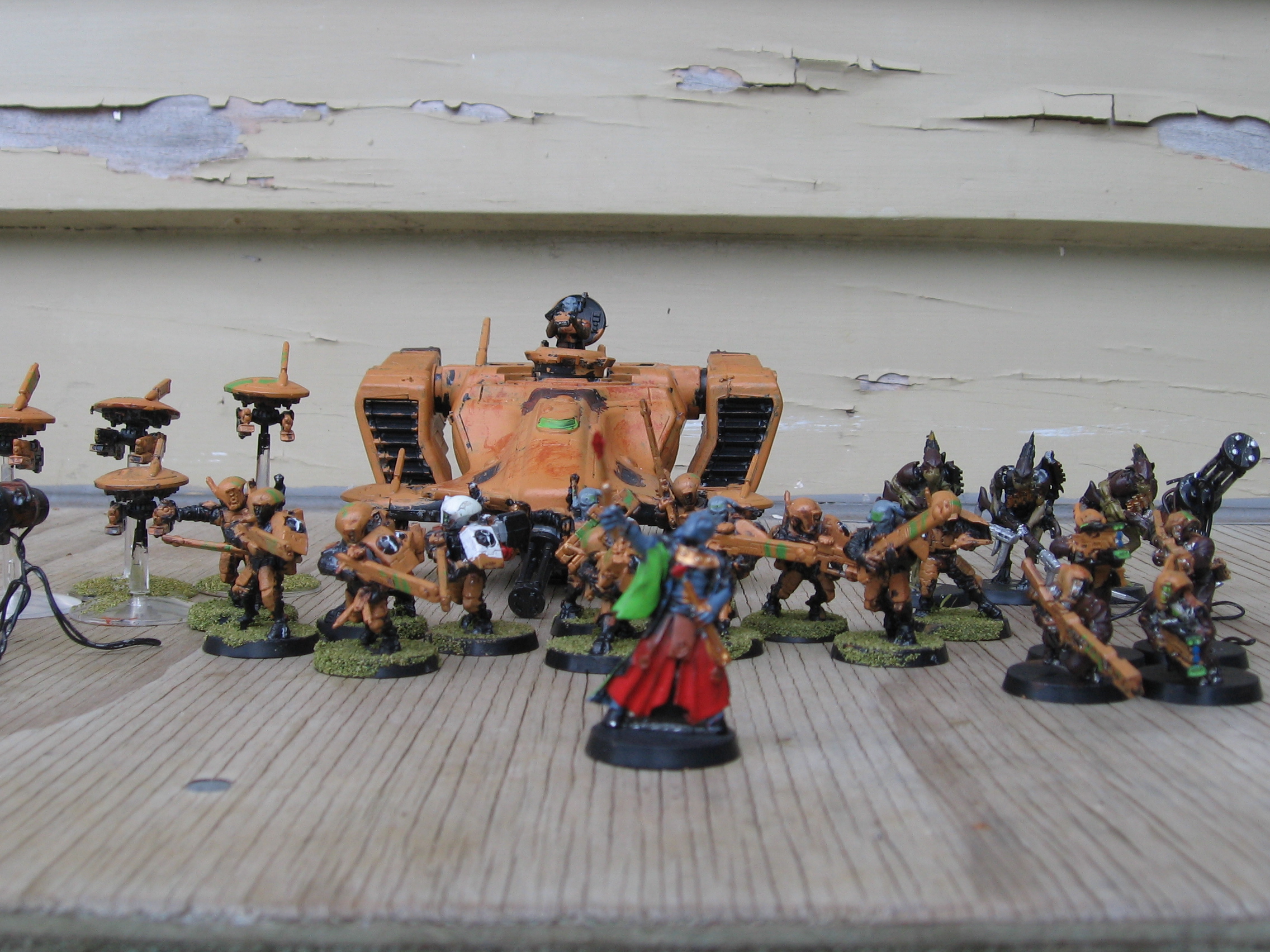


According to the image tags, this picture was taken in early 2006, when I was 11, after I had been working on the Tau army for 4 years. 


And now, here are their successors, 17 years later. 


Now my army has a solid core of troops, first rate leadership, and wide range of units and weapons including infantry and jump infantry. With the main command and control structure in place it is time to start requisitioning some heavy equipment and get to grips with how the vehicle rules in 40k work...

Sunday, 19 April 2020

Crisis Contained

And now finally for some new models!

What a journey it hass been. When I last updated this blog with some newly painted models I had expected to have the better part of a healthy 1500 points of Tau for Warhamemr 40,000 done by now. I was... very wrong.

However, at long last I can finally share some very exciting news for my Tau project, having finally finished not only the first unit of multi-wound models for the army, and the first unit unit of medium-sized models for the army, and the first unit on bases larger than 25mm (flying bases don't count) for the army, but also my first battlesuit models in almost a decade.

This is a groundbreaking milestone, and the latest in a long and often turbulent history. For you see, I have a dark secret. Beneath all my many layers and masks and acts upon here, at the very heart of my psyche is a hidden canker, a deep-buried heresy so heinous as to be incomprehensibly anathema to other Tau enthusiasts, a blasphemy ruthlessly suppressed and uttered only in hushed whispers. You see...

... I've never really been all that fond of Tau battlesuits.

If you've been following this blog from the start, you'll know that I'm a rare breed in that I was never drawn to the Tau for their battlesuits. It was always the grav-tanks and Fire Warriors that attracted me the most, and even to this day I consider battlesuits in much the same way that many might view the drone units - an important and interesting component of the Tau army and model range, but a secondary one, a side-show to the grav-tanks and Fire Warriors that are the real main event. The exception to this of course is the Stealthsuits, which are close enough to the Fire Warriors that I have always considered them to be separate to the XV-8 family, a kind of 'honorary infantry' if you will.

The Crisis battlesuits were always hit the worst by this. As I mentioned in the first post about my big Tau 40k reboot, one of the first Tau models I had my eye on was a Broadside battlesuit, which I could always appreciate because of their proportions - something about those massive shoulder-mounted guns always seemed to balance them out wonderfully in my eyes. The Crisis Suits, with their comparatively dinky weapons always seemed somewhat lesser to me in comparison. This was only further compounded by the nature of the weapons the models were armed with and my age at the time - the broadsides were very clearly carrying some kind of missile launcher, very easy to both identify and understand for an 8 year old boy with an acute fascination with all things modern military and science fiction, and while a railgun was far less comprehensible at the time, a pair of gigantic intimidating looking cannons was certainly not. The Crisis Suits, on the other hand... well my 8 year old brain just couldn't wrap itself around what a fusion blaster or plasma rifle was supposed to do (it took my 9-10 year old brain to start making progress on that one).

This all added up to seriously stunt my battlesuit forces, until I eventually made a decision to eschew them entirely. I have always had a massive rebellious non-conformist streak, so naturally after a few years of being constantly bombarded by GW's marketing on how much I as a Tau player should love battlesuits, and exposed to how many other Tau players loved them, I decided that I would not include a single XV-8 based battlesuit in my entire Tau army. The Crisis suits I had already obtained would be kept for completeness, but from that day forward whenever my Tau were to do battle they would fight using only infantry, grav-tanks, drones and stealthsuits. "Pfft, who needs battlesuits!" I thought, "I've got pulse guns for dealing with infantry, and railguns and seeker missiles for dealing with tanks. What more could I possibly have use for?"

It was around early 2010ish when that all began to change. After looking again at Crisis Suits, and having begun to get a better grasp of some of the nuances of the Warhammer 40,000 rules (not least among them being the rules for equipping Crisis Teams themselves, something that always been far too byzantine for my primitive child brain to grasp), I began to wonder if we had perhaps gotten off on the wrong foot. This was shortly followed by a growing realisation of the importance of assault weapons in Warhammer 40,000. Then the two came together when after reading more closely through the original Tau Designers' Notes by Andy Chambers I had a sudden Eureka moment and realised that the purpose of Crisis battlesuits was to act as mobile assault weapon carriers for the Fire Warriors.

And perhaps the most profound factor in this change of thinking was that about a year or two earlier I had discovered this strange and wonderful website all about my favourite 40k faction called Advanced Tau Tactica, and had been steadily digesting the wealth of tactics articles hosted on there ever since.

However, this growing revolution in military affairs ultimately failed to materialise any practical changes, as the nascent modernisation of my Tau army was cut short in the tail end of 2010 when all my hobby efforts were redirected towards building my Tau fleet for Battlefleet Gothic, and later a Wood Elf army in Warhammer.

Nonetheless, theoretical consideration and planning continued, in anticipation for a renewed modernisation of the ground forces at some undetermined point in the future, and was only accelerated in 2013 when I was sucked into the buzz surrounding the Tau releases of the time. The profusion of utility afforded to Crisis battlesuits in the 6th edition codex accelerated the development of my battlesuit doctrine considerably, and quickly cemented an important niche for Crisis teams as the key source of essential assault weapons in my future Tau army, with the mobility to get to where they were needed in order to deal with targets that the Fire Warriors could not - just as the original designers of the Tau intended!

Which at last brings us to today, with the first brand-new Crisis Team of my rebooted Tau army. But first, as is tradition, let's step back a way to see where this all began. My first ever XV-8 Crisis battlesuit was this guy.


It also has the distinction of being the second Warhammer 40,000 model I ever owned, and the first ever plastic Warhammer 40,000 model I ever owned (not counting drones). I got him during a visit to the same local GW store where I gained my faithful metal Stealthsuit Shas'vre (see this post), where I was able to play my second ever game of Warhammer 40,000 - an intro game arbitrated by a staff member that saw me trying to rescue an Ethereal from a small force of Space Marines commanded by a family friend we were out shopping with at the time. Unfortunately I fared worse than in my first glorious triumph, and was unable to stop the Space Marines from carrying off the captive Aun - in no small part because of some poor reserve rolls for the Devilfish-mounted reinforcements I was promised which I had made a crucial part of my plan. But this was also my second game ever; tactical mistakes were inevitable.

But I digress. After the game I was once again allowed to take home 'one small thing', this time on a slightly bigger budget that would afford a small boxed model rather than a blister pack. I still wanted that Broadside battlesuit, with its awesome looking shoulder mounted guns and arm mounted missile launchers, but it was still deemed too expensive, so I settled on the only other small Tau box there was - an XV-8 Crisis battlesuit kit (and with the fantastic box artwork found on the 3rd edition kits too no less). It was either that or this other weird looking battlesuit carrying a sword called 'Rebel Commander Farsight' or something, but I decided to go with the box that had the cool artwork on it.

Now, it's important to note here that at the time I was 8 years old, and I had not yet read either the Warhammer 40,000 rulebook or the Tau codex. This is important, because they were both major factors in colouring my perception of the Crisis battlesuit kit when I got home and started inspecting it more closely. Being 8 years old, I had never encountered multi-part model kits before, save for a Chinese-made sci-fi robot toy that fired balls when assembled (in theory), which had been put together by one of my parents without my observation. The closest experience I had thus far had been the plastic model sprues in the Lord of The Rings Battle Games In Middle Earth part-book magazines, but they were almost entirely single-part models with a few push-fit arms and shields.

You can perhaps imagine, then, my total bewilderment when I encountered the Crisis battlesuit sprue for the first time. I had assumed that the Crisis battlesuit would be something like one of the action figures I had played with for years, or perhaps at most something like the Lord of The Rings plastics, with a simple push-fit assembly. The Gun Drone that came with my Stealthsuit seemed to reinforce this idea, being mostly push-fit itself. At first the Crisis battlesuit with its snug-fitting chest piece and many ball joints seemed to meet these expectations, but it soon became apparent that this was misleading - the ball joints at the hip and on the head were deceptively loose, and were quickly found to be impossible to hold in place without glue. The arms and ankles were left unglued for a while, but in time they too were fastened in place with adhesive. I had thought I had stuck the aerials on the helmet, but archaeological analysis suggests that these were left off - presumably my 8-year-old self decided to leave them dry-fitted and they fell off, never to be seen again.

The other point of confusion, which plagued me for years, was the weapon fits. Since my funding was limited, I had prioritised getting models over books and so had yet to read the Tau codex, and consequently I had not the faintest idea what the various bits of wargear included in the kit were supposed to do. My information about the Tau and the setting had thus far come from the GW website, but the Tau unit guide they had up on there at the time contained only vague mentions of "an array of deadly weaponry that can meet almost any threat and neutralise it" in regards to what Crisis battlesuits actually did or how they fought (it should be noted that this descriptive line did not help their reputation in my eyes - as an 8 year old I didn't want to neutralise threats, I wanted to kill, destroy and annihilate them!).

In the absence of any information, I gravitated towards the burst cannon, missile launcher, flamer and shield generator as my first picks for equipment - I had seen the name 'burst cannon' used in several places on the GW and Forgeworld webpages in regards to the Gatling guns featured on Tau units, and as an 8-year old boy interested in science fiction and military hardware I was already fairly familiar with what Gatling guns and missile launchers could do, and it did not take much brainpower to deduce that the funny looking gun with a pilot light on the end and what looked like a fuel tank on top of it was a flamethrower of some kind, likewise that the device which looked like a shield was some sort of energy-shield generator. The other pieces, especially the poor maligned target lock ("Why would I want to put a tiny little extra head on this battlesuit instead of another gun?"), were largely maligned, except for the plasma rifle, which I adopted as a 'cool sci-fi energy weapon' option for the Crisis Suit (because as a keen enthusiast of science fiction computer games I knew you always had to include an energy weapon of some kind along with all the guns and rockets).

At first all of these options were simply push-fit into the various hard-point slots on the battlesuit model, so that I would be able to swap them out between battles. The pieces seemed to fit well enough without glue, and I still wanted maximum variety and flexibility with my battlesuit. Eventually though as I came to favour the above choices over others they were glued in place, resulting in the loadout you see today.

Being the second Warhammer 40,000 unit I ever owned, this Crisis battlesuit shares much of the same history as the metal XV15 Stealthsuit who directly preceded him, and went through much of the same changes in colour scheme, many of which can still be seen on the model in places. At first it was painted in a massively thick coating of sunburst yellow - much like the Stealthsuit, I wanted my Tau to have yellow armour just like the box artwork for Firewarrior that had first drawn me to Warhammer 40,000 in the first place. The exception of course was the mechanical areas, which were left black to mimic the dark gunmetal areas on the GW studio battlesuits.

Then when I had my ill-fated idea to have an army of gold-plated Tau it was hastily repainted with a coat of Mithril Silver followed by a coat of Shining Gold. You can still see how this colour scheme looked on the burst cannon amongst other areas. After a short while I realised I had made a mistake and repainted all of my non-Stealthsuit Tau units at the time (both of them) to the sandy desert camouflage scheme from the GW studio army, starting with a thin (by my standards at the time) coat of Vermin brown and later adding a white helmet. I no longer remember if the white helmet came when I finally got my hands on Bleached Bone paint, or if the off-white cream colour is simply the result of Skull White over Vermin and Vomit browns in sufficient quantities.

The other feature of interest is the Jerry Can glued to the base. While I quickly abandoned conventional basing in my childhood years, I still liked to add objects to my models' bases when possible. This came from seeing the Space Marine my friend at the time brought over one day when I was 8, just before I got into Warhammer 40,000 for the first time. The Space Marine model had a spare bolter glued to its base, and I thought it looked so cool I tried to emulate it myself with other objects. For a while my Stealthsuit had a spare shield drone antenna glued to its base (back when I thought they were rifles and not aerials), and later I decided to mark out my sole Crisis battlesuit by sticking down the Jerry Can piece from the Battlefield Accessories kit I had got some time earlier (which it must be said is a fantastic set of terrain and easily one of my two favourite GW terrain products alongside the Jungle Trees).

Being the only Crisis battlesuit meant that for some time this guy was also the de facto commander of my Tau army for some years, before I finally got an Ethereal in to relieve him of his command duties. He then served as a Monat for a short while before being retired in place of these guys.


This was the trio of Crisis battlesuits that came with the Tau battleforce I got for Christmas when I was about 10, if memory serves. By this time I actually HAD read the Tau codex (and would get a copy of the brand new 4th edition core rulebook to read through not long afterwards), but this did little to enlighten me on the subtleties of equipping Crisis Teams and ultimately ended up raising more questions than it answered in that area. However, I had also read the new interactive flash guide on battlesuit weapons and support systems that was now on the GW website (and can still be found through the Wayback Machine archive), which was vastly more helpful for my primitive childhood brain. This was very strongly reflected in the choice of weapons loadout I gave them - you will immediately note an abundance of plasma rifles, now in vogue because the interactive flash guide suggested they were the best Crisis battlesuit weapon. Of course, like any good military my army had plenty of institutional inertia within it and so there was at least one battlesuit loaded down with burst cannons and missile pods, because you never know when you might need a Gatling gun and a missile launcher. 

The other thing you probably noticed immediately is that this Crisis Team was originally built with four weapons or support systems equipping each battlesuit rather than three. The reason for this is very simple - there are four hardpoint slots on the Crisis battlesuit model, so my 8-9 year old self decided it was only logical that they carry four weapons. I also admired - and still do - the symmetry of having two items on the shoulders and two on the arms (another reason why I always liked the Broadside battlesuits with their twin-linked weapons more). Even after reading through the codex I still thought it made sense to stick four guns and/or wargear items on them because of that - my response to seeing the rules in the codex was "What? Three? That can't be right, it doesn't make sense. They have four slots on the models! Why would they say they you can only take three items when there are four slots on the models?" 

To this day I still cannot help but wonder if once upon a time taking four weapons/wargear items was a feature on the Mk.I-IV Crisis battlesuits that never made it past playtesting to the codex and was never mentioned by Andy Chambers in the Designers' Notes for whatever reason. 

It took me years to realise that the fourth hardpoint slot was really just there to give you some options for visual variety. By that point I had also begun to start giving some serious thought into tactical roles for Crisis Teams instead of just piling on whatever guns or wargear I thought looked cool. I had also started digesting more tactics articles on the internet (not least among them the ATT Academy articles, as mentioned earlier). At this time the classic Fireknife team configuration was in vogue, and so I constantly heard about how the Fireknife was the best Crisis team layout for general combat, especially against Space Marines. So in early 2010 when I was faced with the prospect of my first game of Warhammer 40,000 outside of a GW store against a Space Marine army I immediately concluded I needed to get some Fireknives up and running. 

The trouble was that my funding was still limited, so rather than take resources away from the Broadside battlesuit production that was going on at the time I made the decision to modify my existing Crisis battlesuits to a Fireknife loadout. This was done by the crude and brutal method of simply cutting off their existing weapons and replacing them with plasma rifles, missile pods and multi-trackers, using those already featured on the models where appropriate. Using the Swiss Army Knife I had recently gotten as a Christmas gift to cut through the plastic joins, the process was long and extremely bloody (I went for a few weeks in High School with at least one band-aid on almost all of my fingers), but eventually I succeeded in getting the extraneous weapons off, then blue-tacked the Fireknife wargear in their place as seen in the other image. 

That was how the Crisis Team was equipped for the three games that turned out to be the only time they were ever used in anger. They performed reasonably well, though did nothing particularly spectacular. The plan originally was to glue the Fireknife weapons on permanently and paint them, but I ultimately never got around to it as I put more and more hobby time into Battlefleet Gothic, then Warhammer. So it was that instead they quietly languished in one of my more out of the way storage spaces, silently guarding a collection of bitz piles and boxes while falling into a dire state of disrepair (in actual fact the damage was a result of the rigours of combat - the Crisis suit with the shield generator had its feet break off at the ankles during one game, while the one on the flying stand had its arm broken off in a related accident. They were temporarily repaired with copious amounts of blue-tack at the time, but then left in that state after the pivot towards other game systems). With their front-line duty now fulfilled however, I saw it fit to repair them fully in honour of their faithful service, and then decided to fully restore them to their historical wargear loadouts. 

Of course, even at the time sticking down new weapons and painting them was only ever seen as a temporary stopgap until completely new Crisis battlesuits could be procured, as by this point they had begun to grow on me considerably. It was always planned that replacement battlesuits would inevitably arrive, and fitted with a wider selection of weaponry to handle a wider array of mission types, likely at some time in the near future. The arrival date for these new Crisis suits was pushed further and further back as Battlefleet Gothic and Warhammer became the dominant tabletop games of my hobby, meaning that it was not until 7 years later that things finally started to shift from the purely theoretical. 

But now the new Crisis suits are finally here. At long last, I can proudly present a whole new generation of XV-8 Crisis battlesuits, a total ground-up revamp that takes my battlesuit corps to the next level, a revolutionary advanced design that is every bit the bleeding edge of modern technology and design, radically different from anything that has come before. 


Surprise!

If you've been following this blog for some time now, then the images above will have come as no surprise at all to you. Otherwise if you're very new to the Tau and 40k, these are the original XV-8 Crisis battlesuit models, which I have grown very fond of. After everything I've said about them, it should be noted that even when my fondness for battlesuits was at its lowest point I still thought the models looked phenomenal, just not as much as the Devilfish, Hammerheads and Fire Warriors that I did not think were getting their fair share of the limelight. I still think that they are by far the best Crisis battlesuit models GW has ever produced, and vastly prefer them to the 2017 versions released some years ago. Because of this I made sure to build up a healthy stockpile of the older kits as I was acquiring my new Tau army, alongside a healthy stockpile of the older Fire Warrior kits I love so much (the fact that both kits were included in the Tau battleforce box alongside what were effectively free Piranhas and Stealthsuit sprues was very convenient), enough to make all of the Crisis Teams I had originally planned on. 

I take enormous pride from the fact that there is not a single model sculpt newer than 2013 in my entire Tau army (both planned and painted!).  

Of course, that does not mean that the Crisis battlesuits were left completely untouched - they have had a whole host of modifications applied to them under the hood. The first and perhaps most important feature is the ankle joints, which have been reinforced with metal pins to prevent breakages. But more dramatic still is that these are the first Crisis battlesuits that I have magnetised. 

Magnetising Crisis battlesuit hardpoints is a practice that I had been familiar with for a very long time - ever since first reading about it in the spotlight article on Sebastian Stuart's Tau army featured in the first issue of White Dwarf I ever owned - but had always dismissed as being impractical in the past. I was unaware of any magnet suppliers in my local area, and lacked the tools with which to install them on models. This began to chance in 2013 as I first gained some reasonable spending money for the first time and began to expand my collection of hobby tools as I began to get more and more invested in conversion work, but I still lacked a viable source of magnets until around 2017 or so when I finally performed a google search and found a convenient magnet supplier located within public transport distance, which then turned out to have very affordable 1mm magnets. 

The next challenge was working out how to install the magnets. Most battlesuit magnetisation I've seen has simply glued the magnets into holes drilled into the model's surface, but that approach was quickly deemed unacceptable - I really loved these older models and wanted to preserve as much of their aesthetic design as possible including every last detail I could save. At the same time, I also wanted to preserve the mounting plugs on the battlesuit weapons and support systems, because I've actually always really loved those details and the really nice utilitarian look they bring to the components. 

The solution I came up with was to not install magnets at all in the weapons and wargear pieces. Instead I drilled out the inside of the mounting plugs and inserted lengths of magnetic wire into them, before sealing them in with greenstuff. Then I installed magnets in the hardpoint slots on the battlesuits themselves. This setup preserves virtually all of the aesthetic details of the models, allows any weapon or support system to be placed on any battlesuit hardpoint, and conveniently halves the number of magnets needed to fully magnetise the entire unit. 

The magnets themselves are small 1mm x 2mm square magnets. My original plan was to simply drill out the bottom 'floor' of the hardpoint slots and slot the magnets in place, but they proved to be just a touch too big to fit. This wasn't a problem for the shoulder hardpoints, since it was a fairly simple matter to drill out the floor of the slot while the jetpack pieces were separate, then slide the magnets in before gluing the two jetpack pieces together. The arm hardpoints were considerably more challenging and ultimately required me to completely excavate the hardpoint slots before reconstructing them over the embedded magnets with greenstuff. 

The result is a Crisis Team that can be equipped with any of the weapons and support systems available, as seen below in the classic 'war machine with its entire arsenal of payload options splayed out in front of it' picture. 


Although they are pictured above in what is anticipated to be their default loadout, a team configuration of my own invention. I have always been a huge proponent of versatility and multi-role capability in my units, since that way no matter what the enemy brings and no matter what the battlefield situation is they will always be able to do something useful. This philosophy mixed with my realisation that Crisis Teams are the only source of several key assault weapons in the entire Tau army to produce a flexible multi-role loadout that provides my army with all three of the core essential assault weapons - melta weapons in the form of fusion blasters, plasma weapons in the form of plasma rifles, and flamers for template weapon support. In the process it also produces a team that can deal with almost any threat on the table and handle any mission I throw at them. 

The core loadout was originally conceived during the 6th edition codex (another factor in wanting as many different assault weapons on the same team as possible, because at the time there was a very real possibility that I would only have enough Elites slots for one Crisis Team at most), where it was imagined that the organic hard-wired multi-trackers Crisis battlesuits have in the 6th edition rules would allow them to choose the best two weapons for the situation and thus still yield an enormous amount of firepower. I was somewhat concerned that it may not be viable in 3.5 and 4th edition play, until I remembered that 3 assault weapons is actually the normal amount of an elite unit and adopted the approach of "If 3 assault weapons is good enough for the Imperial Guard, Chaos Space Marines and Orks then it's good enough for me." 

The painting was an entirely different matter to their construction, and was the reason this post was so long in coming. If my Custodian was the painting equivalent of Trench Warfare, and the ATT Orbital was the painting equivalent of Urban Combat, then this unit was the painting equivalent of Afghanistan. All those sharp corners (prone to paint chipping or sliding at the slightest provocation), many many panel lines to highlight, hard to access areas and my obsessive perfectionism made for a lethal combination that kept me trapped in a nightmarish quagmire for over two years and a quarter. It got so bad that I actually gave up - stripping the paintwork I had done with Simple Green and starting over from scratch (I actually ended up doing this twice). Even after I started getting paint results I was content with I still had to contend with the tedious process of carefully working over the waterslide decals with layer upon layer of Micro-Sol until they finally looked nice enough, and the additional challenge of painting up the entire supply of weapons and wargear. There was also another altogether more insidious complication, for in the journey into the Heart of Darkness in the centre of my soul that painting these things became, I also came to a sudden dark epiphany: 

I really don't like painting battlesuits. 

It's not that I don't like the models, or the concept of the unit or the lore or anything like that - like I say I never really hated any of those parts about them to begin with, and they've only grown on me over time. No, rather I discovered that I find painting battlesuits a chore in much the same way that many appear to find painting Fire Warrior units. It seems that where others hold distaste for painting their Fire Warriors and treat themselves by painting battlesuits, I am destined to hold distaste for painting battlesuits and treat myself by painting infantry units (or possibly vehicles, depending on how that turns out...). 

Speaking of waterslide decals, this also marks the first time I have used any in my new Tau army, and indeed the first time I have touched them at all in over a decade (literally in fact - the decals used were from my old Tau army, which I was sure to restore with a coat of Microscale Liquid Decal Film before using). It is also the first time I have ever created and used custom decals of my own devising in the form of the warning markings near the jetpack exhausts, which I painted freehand onto a sheet of Testors decal paper procured from a local scale model hobby store.  The only freehand markings painted directly on the battlesuits themselves were the ID numbers on the shoulders and the red unit markings on the Shas'Vre. 

The paint scheme of course is as close as possible to the colour scheme of the original GW studio Tau army scheme, with the sole exception being the helmet colouring. Back in 2010 when I was first starting to seriously explore the idea of battlesuit units in the army I came up with the bright idea of colour coding my battlesuit teams based on intended mission role. The idea stuck fast, not least because it would give me a chance to play around with some different colours while still keeping the overall army scheme intact. The practice has been applied to all my battlesuits since then, including these ones. Gold Team here is to be one of my general purpose combat units, with no particular specialisation in mind and thus they have no special helmet colour, just the base maroon markings that will be common to all my new armoured units (incidentally also their first appearance in the army). The 'Gold' designation is simply a close approximation to the main colour and sounds a lot more impressive than 'Sandy Coloured Ochre Team'. 

That said, there is by a somewhat uncanny coincidence a very poetic Full Circle with this paint scheme, as it is ultimately the direct application of the very first ever colour scheme I wanted to paint a battlesuit in. Long ago when I was getting into the Tau and Warhammer 40,000 for the first time I was enthralled by the cool desert camouflage the 'Evy Metal studio Tau were painted in (in no small part because it was what the Firewarrior artwork was based on), but I was somewhat baffled by the odd-looking 'bald' white headpieces that the battlesuits had been painted in, which did not really look quite right to me at the time. I instead wanted to paint mine in the same desert camouflage scheme, but with ochre coloured headpieces which would fit much better visually in my eyes. This resulted in a very interesting exchange between me the schoolyard chum who had also gotten into 40k alongside me, when one day I brought up my desire to paint the heads of my battlesuits Vomit Brown in the middle of my excited talk about my new Crisis battlesuit. 

"What! No, you can't do that! You have to paint it how it is on the box!" 

"The Games Workshop staff person said I could paint them however I wanted." 

"But not when there's an 'Evy Metal on the back of the box, then you have to paint it that way!" 

"Not if I don't want to." 

"Yes you do! That would be like me painting my Space Marines red!" 

"But there are red Space Marines. I've seen them myself." 

"Look, trust me, I'm trying to help you here. Do you know what's going to happen if you paint it Vomit Brown, and bring it into a Games Workshop store? They'll all go 'Eeeww, did someone vomit on your battlesuit?'!" 

Needless to say I felt thoroughly vindicated upon reading all the passages in the rulebooks and codexes about how you should paint your army in whatever colours you like. And before you judge that schoolyard colleague too harshly, do remember that he too was only 8 years old or so at the time and just as new to the tabletop hobby as I was. And the colour guides on the back of the model boxes did hold a lot of sway over us at the time, to the point where even I eventually caved to their guidelines and painted my battlesuit heads white, as you can see in the pictures earlier. 

After all that, I like to think I've done my 8 year old self proud with these Crisis battlesuits. But now my forces have grown so large that they now stretch the current command structure to the limits of its capacity. If I am to proceed any further I will need to significantly expand the leadership and command and control of my new Tau army. 

Perhaps I can find more use for that battlesuit hangar...