Showing posts with label White Dwarf. Show all posts

Sunday, 14 November 2021

Evolution of The Tau - Part 1

 Twenty years ago today something happened that changed the face of Games Workshop, and Warhammer 40,000 in particular, forever. 


OK, so it wasn't exactly today. It was actually staggered out over 3 months in 2001, beginning in October and continuing through to December, but this year does mark the 20 year anniversary of the greatest game-changer of GW history (fight me Oldhammer and 1d4channers), and certainly the greatest game-changer in the history of Warhammer 40,000 (again, Die Mad Oldhammer and 1d4channers). If nothing else, it is certainly the most underrated game-changer in the history of Warhammer 40,000, which is objectively provable by way that I have observed virtually no-one on the Internet seems to have even mentioned it this whole month. 


(Now granted, as previously established last time I do live under a rock on a cold dark planetoid orbiting a Black Hole approximately 42 billion light years away from the Earth, so if this isn't the case and there has indeed been a lot of discourse about this on Reddit or Tweet-Tok or whatever the devil it is that young people use to talk about tabletop games on the Internet these days then please do correct me on this in the comments. But my initial Google Search for 'Tau in 40k 20 Year Anniversary' produced precisely two (2) results that were relevant to the topic, so I'm going to assume it's just not being talked about as much as it should)


I am, of course, talking about the introduction of the single most underrated game faction in Warhammer 40,000. 


The Image that got me into tabletop games.


The Tau, in case you aren't aware, are one of the major game factions in the Warhammer 40,000 tabletop game. The short gist of them is that in the game universe they are a high-tech alien civilisation that controls a quickly growing empire in the eastern edge of the galaxy, which includes both Tau planets and numerous other alien civilisations that have joined the Tau peacefully and now coexist with them. In the grand scheme of things, where the various Warhammer 40,000 game factions represent different science fiction tropes, the Tau are your classic Space Opera faction. 


Originally the Tau were planned to be introduced to the game and its players at the end of 2001, but as the release date drew near an executive decision was made to bump them up ahead a month, so they were released on the faithful month of October instead of November. So the legend in the White Dwarf first covering them goes at any rate. 


Clearly someone at Games Workshop knew exactly how brilliant their new creation was. 


Thus it was that this time 20 years ago the world was introduced to the first Tau models ever released by GW - the Fire Warrior infantry troops, the Kroot Carnivore auxiliary troops, and the Gun Drones, along with a Battleforce box set that included all of the above and a group of Crisis battlesuits. Plus the Tau codex itself, of course. 


The following month, November 2001 saw the release of the Broadside battlesuit, the Devilfish and Hammerhead hover tanks, the Pathfinder reconnaissance scouts, the Kroot Hounds and Kroot shaper leaders, the Ethereal leader, and the special named characters of the codex, Aun'Shi and O'Shovah or Commander Farsight as he's more commonly known. 


Finally, December 2001 featured the last Tau releases, the XV15 stealth troops, the Krootox and Crisis Battlesuits as an individual item, leaving every unit in the codex with model representation. It should be noted that as well as the Crisis suits, the Broadside suits, Devilfish, Pathfinders and Krootox were all released right from the start in October as part of an army box set deal, because as BOLS points out some things never change. This army box set also included a special edition Ethereal model that was just about never released as a standalone model, which was a thing that all of the army box sets at the time did because GW in 2001 was just that awesome. 


FUCK. YEAH. (Image taken from Worthpoint)


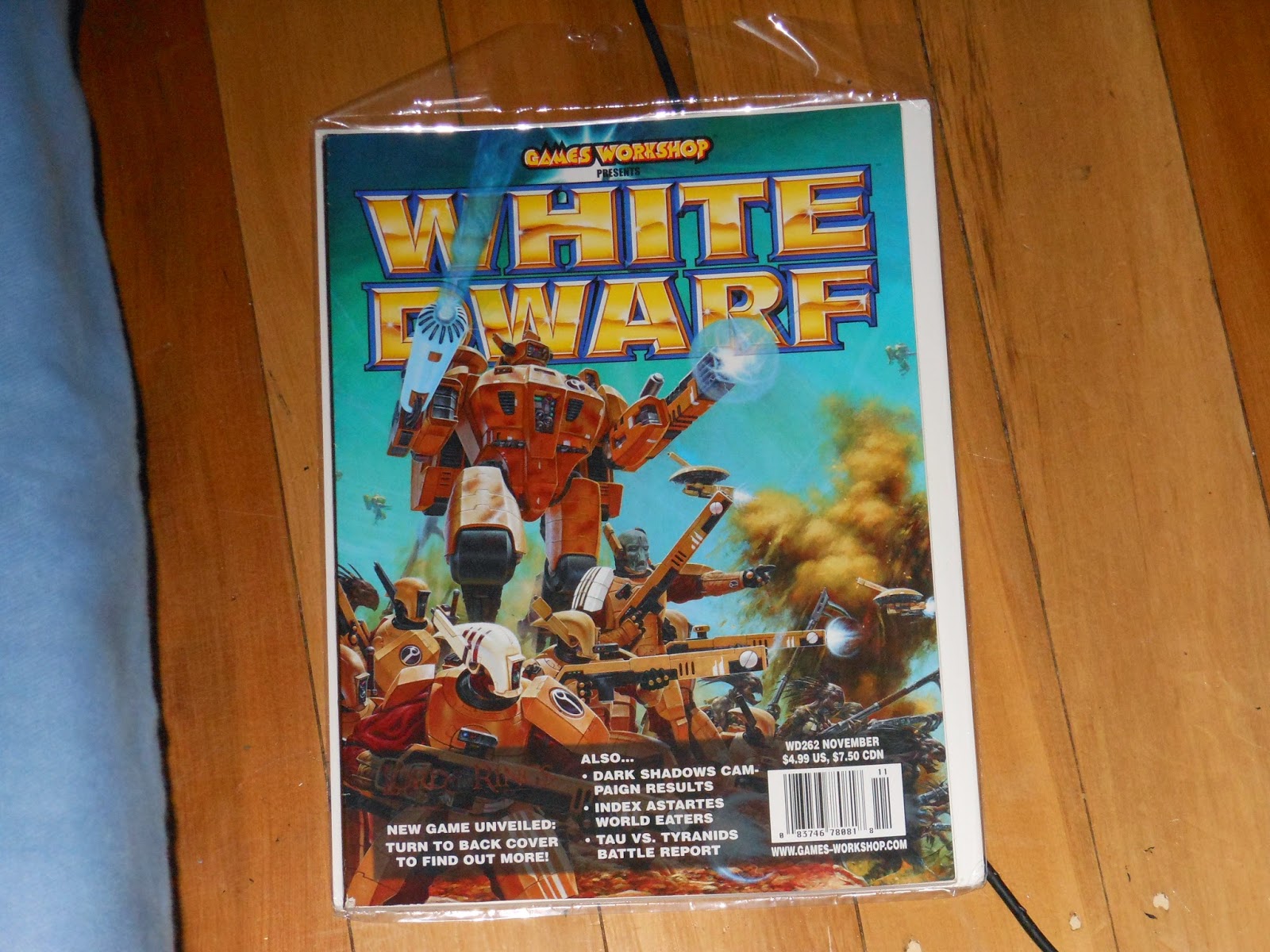
The written material for the Tau was similarly staggered, with an Index Xenos lore piece and basic rules for Fire Warriors included in White Dwarf #261(US) for October 2001, and the bulk of the release content a month later in White Dwarf #262. It is here that the Designer's Notes for the Tau were first published. They are still available on the original GW website, accessible through the Wayback Machine internet archive, and are strongly recommended reading. 


It is in these Designer's Notes, penned by the God Emperor of 40k Andy Chambers himself, that the origins of the Tau are revealed. In the tail end of the 1990s and the dawn of the 2000s (presumably, given the average 2-year production cycle of these things), the decision was made in Games Workshop to add in a brand new game faction for the Warhammer 40,000 franchise, something fresh and unique to shake up the status quo of fantasy civilisations in space that had largely crystallised in 40k by around half-way through 2nd edition, more or less. The only trouble was, the Games Workshop designers had no idea what it should be. They had an enormous list of possible concepts to develop, and even after extensive narrowing down they became deadlocked on two options: either expanding on the Kroot, a minor alien civilisation briefly referenced in the 3rd edition 40k Rulebook, or developing a total clean sheet alien concept called the Tau. 


It was at this point that 40k developer Rick Priestly stepped in, and made like the girl in the Old El Paso ads. 


Rick Priestly, circa 1999-2000, probably

And so the two factions were developed simultaneously, with the Kroot evolving into one of the most important alien allies of the Tau, and foil for them conceptually and aesthetically - one is a bright altruistic unified force of high-tech aliens, one is a scattered species of semi-nomadic tribes and warbands of brutal but technologically limited aliens, TOGETHER! They save the universe! 


I'd certainly watch that show. 


At the heart of the Tau concept was a determination to have a clean break from the rest of the Warhammer 40,000 setting. The Tau were envisaged from Day 1 to be a direct foil to the other 40k factions, an island of good honest positivity in a sea of Grim-Dark despair and horror. In the words of Andy Chambers: 


"In contrast to the other races, we wanted the Tau to be altruistic and idealistic, believing heartily in unification as the way forward."


And if it were up to me, that quote would be laser-etched into the cover of every Tau-related product Games Workshop ever released. It would also be burned into the front door of whatever department or writer was tasked with working on them, and perhaps tattooed onto said writer's forehead as well for good measure. 


For the purposes of growing the franchise and keeping it relevant, this concept was a stroke of genius, and also perfectly filled a notable thematic hole in the setting to boot. You see, up until 2001 40k had always been missing a Space Opera faction in its lineup. Not a Skulls and Candles gothiced up Space Opera faction like the Imperium, no I'm talking a real Space Opera faction - no skulls, no candles, no hoods or ominous latin, no religious dogma, just good old fashioned Enlightenment ideals and good honest science and technology and innovation, populated by good honest explorers and scientists and artists and intellectuals all striving to solve problems with their heads (and the occasional death ray or nuclear missile or 10) rather than a chainsaw. 


For the first decade or so of 40k's existence there wasn't anything like that - the Imperium and Space Marines in particular kind of skirted around the periphery of it in Rogue Trader but dropped any pretense of trying to appeal to it VERY quickly and the last vestiges of that were largely gone by the middle of 2nd Edition. And this is particularly painfully conspicuous because until 2001 40k had just about damn near every other flavour of science fiction civilisation in existence featured in some shape or form. Space Bugs? Check. Mad Max scavenger punks? Check. Crystal-powered science fantasy? Check. Cyberpunk? OK that one sort of slipped through a little as well but the Imperium still retained a lot of that long past Rogue Trader. Check. 


Everything except an honest normal good ol' fashioned 20th Century Space Opera civilisation. The Tau filled that niche wonderfully, completing the full spectrum of Science Fiction Trope Deathmatch that is Warhammer 40,000. 


"Now you see here, you no-good bleeding heart snot-nosed little Simp Cuck fake fanboi," I hear from the festering pit of hate that is the comment sections of the internet, "40k got on just fine without any of this honest wholesome Space Opera stuff for 20 odd years, and it can get on just fine without it now!" 


Well Mr (or Ms, but with language like the above who are we kidding here) 2nd edition worshipping Dankhammer Keyboard Warrior, that brings me to the second aspect of the genius behind the design and inclusion of the Tau. 


See, 40k fans like to talk about themselves as the centre of the pop culture universe, or at least the science fiction pop culture universe, but the bitter truth is even within that very specific niche of a niche we're a minority (a vocal minority at times, but a minority nonetheless). There are a lot more Star Trek and Star Wars fans than there are 40k ones, for example, and I'd wager there are probably more Starcraft fans than 40k ones as well. And that, in no small part, is because the bitter truth is that 40k is pretty niche even by science fiction standards. Let's be honest here, it takes a very specific mindset to fully get into the groove of a lot of 40k, to fully appreciate the concept of fantasy Orcs with guns and spaceships or gothic lovecraftian chainsaw insanity, and a lot of people just don't get it. I know this because I've learnt it the hard way in my ill-fated attempts to get people interested in the tabletop games I enjoy, where I have had a precisely 0% success rate and a precisely 100% incidence of confused but well-meaning smiles and nods and "Oh yes that's... very interesting." 


The bitter truth is, in the grand scheme of things most people, even most sci-fi enthusiasts, just aren't that interested in playing games as skull-encrusted medieval lunatics with chainsaws in space cathedrals. And that gets even more apparent when you step into the vast endless abyss of people who aren't major consumers of science fiction. 


Enter then, the Tau. A 40k faction for the normal sci-fi fan, a 40k faction for the normal tabletop gamer, nay, a 40k faction for the normal pop-culture consumer given the leaps and bounds science fiction has made in breaking through to the mainstream. By existing in the 40k setting as this nice good-natured progressive Space Opera faction, the Tau provide a gateway into the 40k franchise for a whole range of people who could be interested in science fiction tabletop games, but are put off by the other 40k game factions. And this is a very good thing for two reasons: 


1) It means more customers, thus growing the business and getting the game company (GW here) more money. 


2) It means more people playing Warhammer 40,000, thus growing the player-base and making it easier to find gaming opponents and connect with people over this tabletop thing. 


The technical scientific term for this situation, used by leading experts and Industry Veterans alike, is a Win-Win. 


And there's concrete evidence for this working. You're reading it right now. The truth is, if the Tau hadn't been created there is no question that I would have given 40k a hard pass, never gotten into it, and by extension probably never have gotten into Tabletop gaming at all. Somewhere out there is a Millitant in a parallel dimension where the Tau were never created, writing comfortably about the sad state of computer gaming from his tricked out custom PC rig created from parts purchased with all the money he never spent on tabletop games. Either that or he plays electric guitar and writes about that. Or he works on cars or motorcycles or something I guess. Point is, in that parallel dimension where the Tau were never created for Warhammer 40,000, the Millitant that inhabits it does NOT have anything to do with tabletop games. 


I am exactly one of those people who the Tau were aimed at, and it worked like a charm. And where there's one case of that, it's almost certain there's more. 


But it's not just about real world Doylist considerations. The Tau as a bright happy genuinely noble and altruistic good guy force enriches the wider Warhammer 40,000 setting enormously as well. Right off the bat they act as a moral counterweight to the rest of the setting, a kind of safety valve for avoiding burnout from Darkness-induced apathy, because even if you are into it Grimdark gets exhausting after a certain point. It is a horrible irony that all to often I see comments online about people clamouring for something lighter in 40k for a break in the grim darkness, despite the Tau being RIGHT THERE. 


It goes deeper than that though, because the presence of the Tau as genuine legit good guys also enhances the grim darkness of everything else. Part of this is the juxtaposition between the Tau and everyone else - after all you can't really have darkness without light to contrast it against. But it's more than that, because the very existence of the Tau as these good guys also has extremely grimdark implications for everyone else's actions. Because their presence proves that classic good guys can thrive in the Warhammer 40,000 setting, it takes everyone else's horrible actions from being born out of simple necessity to deliberate, purposeful choices driven by character flaws - in other words, classic tragedy. 


Think about it. how much more grimdark is it that, after uncounted thousands of years of unrelenting horror and bloodshed, when the powers of the galaxy are, at long last, finally presented with a genuine legitimate bona fide way out of this nightmare, their reaction is to ignore it and continue on with their unending bloodbath, possibly going so far as to try and stamp out this way out if the opportunity arises - all because they're too cowardly to take it, or too greedy, or too prideful, or too stubborn, or because it would mean they can no longer reap the benefits of the utterly broken systems that are the status quo, or even just because they're simply too institutionalised to the suffering; that after 40,000 years and countless generations of unending slaughter they're just no longer capable of adjusting to or even comprehending a reality that isn't drowning in horror and death. After all: 


"It is not the Horror of War that troubles me, but the Unseen Horrors of Peace."


So much more Grimdark and interesting than "herp derp they have sterilisation camps after all" (We'll be back for you later). 


But themes and concepts alone don't comprise a tabletop faction. Being a tabletop miniatures game made by a tabletop model company, the Tau needed a strong coherent visual style to produce a range of fantastic looking models so that lots of people would buy them. The GW studio designers more than delivered, creating a range of beautiful models with a completely unique aesthetic design. Even so, all art is a process of evolution, with all artistic creations inheriting from the influences that first inspired them. The Tau are no exception, and there is one source of inspiration behind the Tau style that shines through more than any other, a source material whose fingerprints are unmistakable and clear for all to see on the design style of the models and even the thematic tone of Tau lore. 

There can be only one classic pillar of science fiction to which I am referring to, a unique and easily recognisable visual art form from an Island Nation, a visual art form that is beloved across the world and renowned for its bold striking style and dynamic futurism. I am, of course, referring to... 


SUPERMARIONATION!


The genesis of the Tau. 1960s, Colourised


In case you live in one of those savage backwaters where its glory was never syndicated, or if you have the misfortune of not existing until after the shows were aired, SUPERMARIONATION is a screen media format created in Slough, England by Gerry Anderson with the help of Sylvia Thamm (who he later married). It was primarily made for Television broadcast, but also produced a couple of films as well. It consisted of building the most breathtaking, jaw-dropping, awe-inspiring model scratch-builds and kitbashes ever conceived by human minds...


... and then BLASTING THEM TO KINGDOM COME on camera. 


Oh and there was usually some stuff about characters portrayed by puppets thrown in to string the model explosions together into a coherent story too. 


But aside from the monstrous explosions that put Michael Bay films to shame (and since these shows were made before computers were much of a thing, they were all practical too - every time you see something in these shows explode, they blew it up for real), the thing that stands out about Supermarionation is its distinct art design and visual style, a design aesthetic that has never really been seen before or since. It's a striking design language, full of dynamic futuristic architecture and vehicle designs with lots of clean Utopian future technology. 

Now why does that sound familiar? 

Even as an 8-year old kid, the Supermarionation influence on the Tau design was obvious to me from the moment I first laid eyes on the models. In fact, the first time I ever saw pictures of the Forgeworld Tau aircraft my first reaction was: 

"Oh my god, they're like the planes in Thunderbirds!" 


In the beginning it was the intakes that first cued me in. Those huge square intakes with their solid grating in the inside remain one of the most easily recognised parallels between the Tau and Supermarionation designs. Just look at one of the best examples of these in Supermarionation, the prow intake pods of Skyship One from the film Thunderbird 6


The anti-gravity zeppelin my childhood was built on


In case you missed what I'm talking about, here it is again with the big square intakes and their solid grills highlighted. 


And here they are again on the Tau Tigershark aircraft. 

The Tau aircraft diorama my Warhammer 40,000 is built on.


Like I say, when I was looking at that thing on the Forgeworld Website (and its little brother the Barracuda), Thunderbirds and Skyship One was immediately the very first thing that came to mind. And the fact I watched Thunderbird 6 on VHS a hundred times when I was in Primary School can't take full credit for that. The design cues are there. 

And there are certainly more of them. For a very long time I couldn't quite put my finger on them exactly, I simply had a vague gestalt awareness that these models had an obvious Supermarionation influence. But recently I've finally been able to identify what it is - a common visual design language. 

See, the Tau models - and by extension Tau technology itself - are built on a very simple but effective visual style at their core. At the heart of the Tau aesthetic is a body of hard solid angles, that are punctuated by a few sleek curves. This design language crops up everywhere in the Tau model range, from the Fire Warrior infantry to the battlesuits and all the way up into the vehicles that are the stars of the Tau range. 

And it's the same visual design language used throughout Supermarionation shows - hard, solid angles punctuated by a few sleek curves. 

In the case of the Tau vehicles specifically, they also share another unifying feature - a pod like control centre or cockpit, semi-inset with a raised superstructure, with a slit-like forward vision block, and normally located in the centre of the vehicle's front. This is important, because, surprise surprise, the same feature shows up in a lot of Supermarionation vehicle designs too. 


Just compare the Martian Space Probe transporter from Thunderbirds


Or Thunderbird 4 itself 


Alongside the Tau Hammerhead Gunship: 


Tau in 40k are GO...


Admittedly it's not quite as blatant when you can't get the angles on the example shots to match perfectly, but hey I have to work with what the Internet gives me. Point is, the visual design and style influences are clearly there to see. And of course they are, because it makes such perfect sense given how closely the Tau dovetail the themes, atmosphere and tone of Supermarionation shows, especially Stingray and Thunderbirds.

Now none of the GW studio people ever explicitly mentioned Supermarionation when discussing the Tau in the Designers' Notes for them, but they don't have to because it goes without saying. I know that Supermarionation was a huge influence on them, because they were (mostly) British lads who grew up in the UK post-Supermarionation, and it was one of those game-changing phenomena that colour everything that comes after them. It's the same reason why it's a big influence on me and a lot of my science fiction stuff outside 40k, because there was just no escaping it in 1990s Aotearoa either. 

And what a legacy to incorporate! 


Right then, that about wraps things up for this instalment! The Tau have been a fixture of 40k for 20 years now, and it's fair to say they've earned their place as one of the key iconic factions of the setting. Next time on this blog we should be back to showcasing some painted models that I've finally at long last finished so be sure to come back for- 

What's that?

Eh? what? 

What do you mean? 

Really? 

Ugh. Fine. 

I suppose we probably need to address that other artistic medium that gets brought up all the time, if we really must. 


So for most of their lifetime as a game faction the Tau have been commonly labelled "The Anime faction". This mostly stems from their use of large bipedal robot walkers, which are a common staple in science fiction Anime, and some references in the Tau Designers' Notes. I mean... I can see where people can come from there, but the label has never sat right with me at all. It feels like a big disservice to the Tau in rendering them down into a single one-dimensional concept, and ultimately lies at the heart of some problematic decisions GW has taken with the model range in recent times (again, we'll come back to this later). Ultimately I can't help but feel like far too many people allow a couple of off-the-cuff throwaway lines from the Designers' Notes to do their thinking for them. 

And they ARE off-the-cuff throwaway remarks. How do I know this? Because the GW studio designers themselves downplay them in the very Designers' Notes they feature in: 


"[The Tau Battlesuits] had obvious Manga influence, but we tried to steer away from any one inspirational source, gleaning our ideas from a wider range." 

Those are Jess Goodwin's own words. It's the same with the Ashigaru influences on the Fire Warrior infantry armour - they're downplayed in the same sentence they're mentioned. 


"The Fire Warrior armour was suggested by Japanese Ashigaru foot soldiers, but we only wanted a subtle influence to come through."


Emphasis mine in both cases. The GW studio designers who originally worked on the Tau clearly never intended them to be only a shout-out to science fiction Anime and Manga. Indeed, the message that shines through in the Designers' Notes is that what the GW studio designers DID intend for the Tau was to be a beautiful creative maelstrom of different influences and ideas coming together into an organic combination that produced something both fresh and inventive and greater than the sum of its parts. 

"It had been agreed that the Tau were to be a high tech race, and, with this in mind, I tapped into a wide variety of science fiction elements to come up with my first concept sketch. This was the basic premise behind what was eventually to become the Battlesuit." 

(So even the Battlesuits themselves were born from so much more than just Anime and Manga)


"Although the initial sketches bear some resemblance to the final product, the Tau were born from an amalgamation of ideas that worked off each other to produce the final range.

 
"One of the best aspects of designing the Tau force was that we were all working on pieces at the same time. This resulted in a wide range of individual's ideas which all pulled together.


And Jess Goodwin is right here. There is so much more to the Tau than 'Anime shoutout', and even a cursory glance over the model range reveals so many more core pillars of their premise than that - I've highlighted the obvious Supermarionation influence already, but even that doesn't even touch on the enormous obvious influence that classic 20th Century Space Opera had on the Tau, both in their visuals (many Tau models, ESPECIALLY the Kor'vattra starships, would be right at home on the pages of Mechanismo or Terran Trade Authority) and their lore, with its strong emphasis on exploring the cosmos and abundance of characters who prefer to solve problems with their words and wits over violence, as well as the very strong Enlightenment ideals that science, reason and technology can solve any problem that are baked into the Tau DNA, and the Tau operating on an overall somewhat harder level of science fiction than the rest of the 40k factions. 

It's the same with all of the 40k game factions. Like the Tau, each one is to a greater or lesser extent the product of a wonderful fusion of different influences and inspirations and ideas that's more than the sum of its parts, and rendering any of them down to a single root concept cheapens them. The Necrons are far more than just Undead in Space, they're just as much a love letter to the Faceless AI machine overlords in science fiction and H.P. Lovecraft. The Orks are far more than just Tolkien Orcs in space, they're just as much a love letter to Mad Max post-apocalyptic scavenger punk science fiction and Punk subculture in general. The Eldar are so much more than Tolkien Elves in space, they're a love letter to the mythic Planetary Romance Science Fantasy subgenre and classic 1900s - 1940s space opera, and even had strong Anime and Asian pop cultural influences long before the Tau arrived on the scene. 

So it is with the Tau, as much - if not more - a love letter to classic 1950s - 1970s space opera and Supermarionation as they are an Anime shoutout (as well as having a little bit of 1980s-1990s cyberpunk thrown in for good measure). 


And with that, we can at last finally come to the conclusion of this thrilling first part into a deep dive of the Tau, who have now been conquering the 41st Millennium for 20 years and with any luck will be conquering it for many more to come.

Saturday, 15 October 2016

The Glory And The Scum

Where is it!! WHERE IS IT!! It was here only a day ago! WHO HAS STOLEN MY RIGHTFUL PRIZE!! YOU DARE TO ROB ME OF WHAT IS MINE!? YOU WILL PAY DEARLY FOR YOUR DEFIANCE!! I WILL HUNT YOU THROUGH ETERNITY IN THIS LIFE AND THE NEXT!! YOU WILL NEVER BE SAFE FROM MY WRATH!! MINIONS! TO ME!

Ahem. So as I was hitting up the local second-hand bookstore I managed to find another lot of old Warhammer books.


They're the 3rd edition Codex: Tyranids and the 6th edition Chaos Warriors army book for Warhammer Fantasy (back when it was Hordes of Chaos and Demons were still part of the book. Ahh those were the days). There was also a copy of the 3rd edition Space Marine codex and the 3rd edition Warhammer 40,000 rulebook. I was going to get the 3rd edition rulebook, but in between me checking it was still there and actually going to buy it (two consecutive days) some bastard swooped in and bought it before I could. The Space Marine codex was left, and as far as I am aware is still there. I was tempted to buy it as well, but I'm not really sure how much use I'd get from it since I have no desire at all to ever own a (loyalist) Space Marine army, ever.


The 3rd edition Tyranids codex was admittedly my main target, and was an extremely fortunate find as it was the next 3rd edition codex I wanted to get after the 3.5 edition Chaos Space Marines book. I have plans, you see, to get it and the 4th edition Tyranid codex that followed it in order to try and compile a full catalogue of every Tyranid biomorph that's been published in Warhammer 40,000's history. An impossible task to be sure, for the Great Devourer is constantly mutating and evolving, but I want to get a good idea of all the biomorphs that have been featured and what they do for use in designing homebrew rules.

A cursory look through Lexicanum seems to indicate that this was the last of the 'first generation' of 3rd edition Warhammer 40,000 codexes, released just before the famous 3.5 edition books, and it definitely shows. From the artwork to the background stories to the overall layout, the whole book feels like a prototype 3.5 edition codex. The cover artwork has the same sort of gritty, realistic style as most of the 3.5 edition cover art (in sharp contrast to the more vividly colourful first generation 3rd edition codex covers), and it's easily my favourite out of the Tyranid codex covers. The tortured, dying sun, the pack of gaunts barrelling straight towards the viewer, the sickly green glow from the barbed strangler, the fantastic use of indistinct background shapes and the dark brooding colour scheme all drive home exactly what the Tyranids are to me. The internal artwork also has a distinctly 3.5 edition feel, with many pieces in the softer sketch style of the late 3rd edition period rather than the comparatively sharper and more immediately Blancheian early 3rd edition artwork. There are a few exceptions, some of which (like a small piece at the end of the book depicting some giant Tyranid spores drifting between celestial bodies) would later end up in Battlefleet Gothic: Armada. There is also a delightfully creepy background art on many pages that mimics the amazing inside cover, which lends a fantastic ambience to the book.

It is still at the same 40something page length of the early 3rd edition codexes, but pound for pound there's an astonishing amount of stuff in there. The rules are somewhat light, especially for biomorphs - I was expecting that most of the biomorphs featured in the 4th edition codex would have gotten their start here, but it seems like many of them (especially the Carnifex upgrades) were invented for the later book. Consequently the 'armoury' section is fairly thin, with most of the customisation options coming from the optional mutation and genetic engineering rules at the back of the book. The unit and weapon stats had some interesting features, bio-acid spore mines weren't quite as hardcore as I was anticipating them to be, and I'm still struggling to imagine why I would want to use Devourers, especially on gaunts - I know the models look pretty funky, but I'm just not sure exactly what 2 strength 2 shots are meant to accomplish. Is it a numbers thing where you're aiming to force wounding 6s and failed armour saves through sheer weight of dice? They seem slightly better on Warriors and Raveners where they get bolter strength and 6 shots each respectively, but then I can't help but think how much better Deathspitters look since they have better range, AP and strength, and seem like they'd hit just as many enemies per shooting round since they're blast weapons. Likewise rending claws seem kind of redundant on the monstrous creatures since they already ignore armour saves automatically, unless you want to giggle about Carnifexes getting AP22 against vehicles in close combat (which admittedly is kind of fun to think about). Ah what do I care, it's not like I've ever been interested in the competitive gaming side of this hobby anyway.

Speaking of non-gaming stuff, there's a healthy colour section nestled in the middle of the book with a lot of helpful hobby material and a layout that's eerily similar to the colour section in the later 3rd edition Tau codex. It has guides on converting and assembling Tyranid models, as well as plenty of photos of what is actually my favourite incarnation of the Tyranid model range. Yes, I like this one more than the 4th edition range - THERE I SAID IT! The 4th edition range has a lot of nice technical attributes in the form of bits and opportunities for customisation, to be sure, but in terms of aesthetics the 3rd edition range has it pretty solidly beat hands down as far as I'm concerned. The scything talons look like actual talons on the larger models (whereas the ones on the 4th edition models tend to look more like long chitin-covered fingers to me), and the whole range just looks more threatening to me than the later versions (I've never understood the 'friendly smiles' complaint that gets levelled at this range a lot - the grins on the models always looked more psychotic or sinister to me). Most of my favourite Tyranid models are also from this time, including the 3rd edition Lictor and Biovore (for some reason the later versions of them just never looked right to me), the Raveners with their wicked looking maws, the Tyrant Guard (I always liked the 'elite warrior bodyguard' style of the 3rd edition Tyrant Guard rather than the pudgy balls of chitin from the later editions) and of course the awe inspiring 3rd edition Hive Tyrant. I even have plans to convert one of the newer Hive Tyrant models back into the 3rd edition style if I ever start a Tyranid army...


Since I couldn't get the 3rd edition rulebook, I consoled myself with this, the 6th edition Chaos Warriors army book for Warhammer Fantasy. I don't remember exactly how it was received at the time, and I have some trouble discerning the community's memory of this book with that of the 7th edition one (wait there was a 7th edition Warriors of Chaos army book right? I distinctly remember there being one, that was an actual thing and I'm not going insane yes?), but GW certainly seems to have made a big deal about it at the time - right after the contents page there's a page-long introductory spiel about how this book will change everything for Chaos armies (There's also a corresponding page at the back with advice on how to proxy older Chaos models not represented in the book as stuff that does have rules for it in the book, which I quite liked) along with the later Beasts of Chaos army book and a mysterious second companion book that never seems to have materialised.

As far as army books go, it's massive - easily the lengthiest one I've come across so far, and full of background information about Chaos and the Northern Chaos-worshipping barbarian tribes of the Warhammer World, and a lengthy army list section not entirely unlike that of its 40k cousin the 3.5 edition Chaos Space Marines book. However, I've never actually been that interested in the Warriors side of Chaos in Warhammer Fantasy (or the Chaos Space Marines in 40k for that matter - it's always been the creepier sinister insidious paranormal horror side of Chaos that's interested me rather than the fightey punchy heavy metal side), so really the main reason I wanted it was to plunder the magic items section for goodies to give the Beastmen army I wanted but will almost certainly never get (the magic item armouries in the two army books are inter-compatible with one another you see - as I understand it a Beastmen character can take stuff from the Chaos Warriors armoury, and vice versa). There were a couple of things in it that caught my interest, like the Hellfire Sword or the Blade of Blood, but ultimately I was kind of let down by the magic items - again, they mostly seemed to be of the whole raging fighty warrior style of Chaos, and that's really not what I'm looking for when it comes to the Ruinous Powers. Still, there's a lot of neat stuff in that book.


If you follow GW news a lot then you'll probably know that they recently switched their hobby magazine, White Dwarf, back to a monthly format after a stint as a weekly pamphlet. I was going to write something about this sooner (I've actually had this copy for a few weeks now), but something came up and I had to delay this whole post by a couple of weeks or so. Unfortunately at least half of the content featured in it is for a system I have absolutely no interest in whatsoever (and no GW, taking the 8th edition Dwarf Slayer model and giving it a new paint job does not make it a special Grombrindal model), so it was off to a bad start already, but on the positive side I was pleased to see two female White Dwarf team members featured prominently on the staff list inside the cover - as someone who has wanted for some time to see more... girls? Women? Ladies? I'm not quite sure what the most appropriate term to use here is, but more female hobbyists at any rate (and more female computer gamers too for that matter) I'm always glad to see a blow against the whole male dominated hobby thing. All genders should be welcome in the world of tabletop wargames.

Other features include some background stuff about Imperial Knights, which might have excited me 5 or 6 years ago but is now of little use since I've grown almost entirely self-sufficient when it comes to tabletop background material (3-10 years of stupid official background will do that to you) and some designers' notes on the ungodly eyesore that is the 8th edition Nagash model released for the thrice-damned ET series, which much like the 8th edition Treeman model and its unclean spawn in the AoS sylvaneth range possesses an uncanny ability to make my blood boil even now over a year after its release. Ultimately it was a good attempt at putting more content back in, but after experiencing the glory of the early 2000s era White Dwarfs I don't think anything will ever truly compare.

The most profound reaction I had, however, was with the featured army of the month, a very large Biel-Tan Craftworld Eldar army featuring some damn fine paint work. Reading about it though, and some of the history behind it, I couldn't help but feel... sad. I've touched on the death of most of my hobby dreams a few times before, but one in particular I don't think I've mentioned yet is that I've sort of always wanted to have one of my armies or fleets featured in a White Dwarf article. Ever since I first started reading through White Dwarfs (and even before then on the old GW website) I would always liked looking at the featured armies (starting with none other than the legendary Tau army of Sebastian 'Tael' Stuart himself in the first issue of White Dwarf I ever purchased) and reading the owner's commentary about them - what made them go with that paint scheme, where the idea for the army came from, how they did this particular conversion and so on, and I would always dream of one day seeing my own army (later armies when I expanded into more than one) featured in White Dwarf so that other hobbyists might enjoy reading about it like I had before them.

Unfortunately it seems that my views have become diametrically opposed to GW's. I hate metaplots like the one they torpedoed Warhammer Fantasy with and the one they're driving into 40k, and I genuinely see nothing good in just about every GW model released in the last couple of years (the closest I get to having a positive thing to say about them is the occasional "Meh... it's kind of ok... I guess..." or "I suppose I could use one or two parts from that in a conversion... maybe..." which is a very far cry from the "WOW that's awesome!" that literally any GW model released between 1999 and 2008 universally gets from me, or the "Hey that's pretty neat/cool!" reaction that any GW model from before 1999 gets*). Ultimately, all the GW and Forgeworld models I love are from the past, not the future.

This means that in all likelihood I will never get featured in a White Dwarf article, or even on the GW website. My armies/fleets will never be showcased in lavish professional photographs, I will never be able to share any anecdotes or cool stories with millions of readers across the world, and worst of all I will never inspire another hobbyist the way the ones featured in those showcases inspired me. The closest I'll get is this blog, and considering that it's buried under 4 and a half pages in a google search for 'Naked Metal' I'm not sure how many aspiring young hobbyists are going to find it...

On that note however I do wish to express my immense joy and excitement at GW's new 'Made to Order' service for older models. As someone who has been calling for a cast-on-demand archive service for years now I was thrilled to discover the announcement on the GW website and the first wave of old Imperial Guard models to get the treatment. There are still a couple of kinks that could be ironed out (I still think a minimum availability period of 48 hours is too short to reach the most people who would be interested), but it's a definite step in the right direction and has my full support and OHMYGOD They're even in metal!!

Well done GW. Keep going down that path and you might actually start getting more money from me.

Tuesday, 5 July 2016

Lunar Interlude

Classichammer is fucking awesome 
You want a Dwarf army? 


There's your fucking Dwarf army 

You want some newer models? 

Fuck you 

Dwarves can do lots of stuff like enchant artillery pieces. Can you enchant an artillery piece? 

Fuck no 

Play Classichammer


In case you aren't the most internet-savvy, the above is of course a parody of the famous advertisement for popular indie-game Dwarf Fortress (and Classichammer is apparently the name for playing Warhammer Fantasy with 6th - early 8th edition rules like I do). 

I've actually been kind of fond of the Dwarves ever since reading about them in the first White Dwarf issue I ever owned (it was covering the big Dwarf release that happened towards the end of 6th edition I believe, though it may have been 7th by then). They're actually my third favourite 'good' Warhammer Fantasy faction after Wood Elves and Bretonnia, and were one of the factions that were almost my first Warhammer Fantasy army (it came down to them, Bretonnia and Wood Elves, before a combination of falling in love with symphonic metal - specifically Nightwish - and the enormous fun I had playing as a Demon Hunter in Diablo 3 swung things in favour of the Wood Elves). I had planned to build a very large Dwarf army at some point in the future (along with Bretonnians, Beastmen, Vampire Counts, The Empire and, well, pretty much every faction except Warriors of Chaos and Ogres), but then GW brought out the ET series and promptly decided to stop selling Warhammer Fantasy models and my dream of owning gigantic armies for almost every Warhammer Fantasy faction died in agony. 

A while ago however I stumbled upon the above Dwarf battalion set in an out-of-the-way hobby store not too far from where I live, and decided it was too good an opportunity to pass up. I've worked out that if I can somehow find a second Dwarf battalion set, two boxes of warriors and some characters I should be able to put together a modest Dwarf army to act as an opposing force for my Wood Elves and Bretonnians (oh I'll also probably need an army book for it too. And any other extras I can scavenege along the way). And so I patiently waited until the anniversary of my existence that happened a month ago, which left me with a pile of cash to burn. After weighing up my options (the alternatives were either getting an Immolator or two off ebay, some Eldar ships for Battlefleet Gothic, or some Sisters of Battle characters), I decided that getting the battalion set and the other stuff below would give me the most bang for my buck. It's definitely a lot bulkier than the other battalion sets I've handled - with almost a third more volume than the Wood Elf and Bretonnian ones - and indeed when I first saw it I thought it was more than just a battalion set. Despite containing roughly the same value as the other ones (approximately three unit boxes and one small box worth of models), it's also very densely packed with quite a few bits, although most of them are weapon options and the sprues feel comparatively light on fun little doodads and extras, although it occurs to me that I may just be spoiled from the Bretonnian kits. 

As well as getting the batalion set, I also raided the online retailers and ordered up this healthy pile of old GW publications. 


Which includes the second version of the 3rd edition Chaos Space Marines codex, the Eye of Terror campaign supplement, Cityfight, and a bunch of White Dwarfs. 


If you collect Chaos Space Marines or experienced the early 2000s 'Silver Age' of Games Workshop, then this book needs no introduction. The second of two Chaos Space Marine codexes published for 3rd edition Warhammer 40,000, the 3.5 edition Codex Chaos Space Marines is considered by many to be one of the high points of Chaos rulesets, second only to the original Realm of Chaos books and the 2nd edition Chaos codex in the number of options, character and fun it provided. It's also infamous for its variant army lists, which included some insanely powerful options for armies (at the time at least. In an age of Unbound armies, superheavy units and S10 and D strength templates flying around they seem almost quaint now). 

I was a little worried about ordering this one, since it's condition was listed as only 'very good', but initial skimmings have shown it to be in remarkably good shape. I was however slightly underwhelmed by the armoury section. Much like the 2nd edition Sisters of Battle codex, after hearing about it for so long on the Internet I was expecting it to have a colossal armoury section spanning dozens of pages and covering every sort of wargear imaginable, but the actual 'wargear' section of the armoury is surprisingly small and is lacking a few things one might expect (the absence of an Auspex, for example, is particularly conspicuous), with the real options instead being found in the Daemonic Gifts and Veteran Skills (which themselves aren't as numerous as I thought they would be, but then I suppose there weren't as many Universal Special Rules floating around back then) sections, as well as the God-Specific items. Somewhat ironically for a book that's so rules-heavy, I think this is the only 3.5 edition era codex I have encountered so far that does not feature a special scenario somewhere in it, which I find strange the more I think about it. I suppose White Dwarf must have had that covered too?

I do worry about this book though. Whenever I look at it it's like... I can hear... voices... whispering to me in my head... saying that Gav Thorpe is a treacherous monster and that GW hates Chaos Space Marines and only takes away the things that make them interesting to give them to Loyalist Space Marines instead, and that Chaos Space Marines have been ruined since 4th edition.. 


A close relative of the 3.5 edition Chaos Codex, Codex: Eye of Terror was a campaign supplement published to introduce people to the famous Eye of Terror worldwide campaign in 2003. I remember seeing it and the Codex: Craftworld Eldar expansion in GW stores when I was a kid (way back in the glory days when they played metal music in the background and had artwork posted up on the walls. Also when model boxes had actual artwork on them... sometimes...) and wondering why they existed, since my childhood logic concluded that anything contained within them must surely be in the Chaos Space Marine and Eldar codexes respectively. It's about as thin as I remember it, although it doesn't have quite as much content as I was expecting (but then that's only to be expected given its length and nature as an introductory booklet). 

The main reason why I wanted it of course was for the legendary Lost And The Damned army list that allowed for armies of Traitor Guard, mutant hordes and pretty much anything Chaos-aligned that isn't a Daemon or Space Marine of some kind. It wasn't... quite what I was expecting, essentially being a list of things you could take from the Chaos Space Marine and Imperial Guard codexes plus a couple of entries for things not covered by either of those books (like the mutants). In hindsight I'm not really sure what I was expecting from it to be perfectly honest, since from what I gather it was only really ever meant to be a way to port over Imperial Guard units into Chaos armies. I guess an armoury section would have been nice, but really most of that would inevitably just be repeating stuff that's already in the other two army lists, and they had to cram in another three entire army lists as well, so I guess I can understand why there isn't one. The only real serious criticism I have about it is that there's no option for a normal human HQ choice - All the HQ options available are from the Chaos Space Marine codex and so are all, well, Chaos Space Marines. Which is fine if you want an ambitious Chaos Space Marine champion rising to the top on a horde of mortal Chaos followers and mutant monstrosities, but if you want a Lost and The Damned army without any Chaos Space Marines at all in it - like I do - then you're fresh out of luck. I know Chaos Space Marines are supposed to be the favoured champions of the Chaos Gods and so on, and that it is based on a campaign about one of Abaddon's black crusades, but Chaos Space Marine-free Chaos armies do exist too, and would it have really been too hard to add in one little entry for a mortal champion or a rouge psyker or something, or a quick "Traitor Command (use Command Squad rules from Codex: Imperial Guard)" to the list of units you can take? Really?

Fortunately the Adversaries options in the Witchhunters codex provides exactly that - options for regular human Chaos followers - but it has this stupid thing where it says you're not allowed to use them against armies that aren't Witchhunters, and it still feels like an excessive number of hoops to jump through. 

There are also three other lists, for the 13th Great Company of Space Wolves (with the glorious metal Wulfen models of old), the Cadian Shock Troops and Eldar from Ulthwe. They're about what you would expect, with the only really odd thing is the Cadian army list including the options for some Internal Guard units. What's weird about that is that the Internal Guard is charged with eliminating subversive cults on Cadia but is formed from the Ordo Malleus and uses Daemonhunters rules, when rooting out subversive cults is usually the Ordo Hereticus's job. Using Daemonhunters rules is kind of understandable, since the whole campaign happened a year before the Witchhunters codex existed, but actually stating it's an Ordo Malleus outfit and not a Hereticus one in the background struck me as.. off. 

Aside from all that, there's some top notch artwork as well. Some is from other places (I recognised one piece from Battlefleet Gothic), others seem to have been included for the first time here. 


Cityfight was another publication I noticed when I was younger, but never really thought much of it. Rather than seeing it in a store, I first happened upon it on the old GW website, where I looked through the little articles and things in its section, noticed a distinct lack of Tau-related content and promptly dismissed it as not worthwhile (during this time I generally tended to avoid any 40k-related material that did not pertain to the Tau in some way, mostly out of childhood fanaticism for my chosen faction, but also because my time and resources for tabletop hobby were even more limited than they are now, and the army I was building was Tau, so they took priority and everything else just sort of fell by the wayside). I did however get its 4th edition descendent Cities of Death, and certainly found a lot to like in that, so after seeing a few tidbits online and reading the designers' notes for it in White Dwarf #261 I thought it perhaps warranted closer inspection. 

There's a lot of artwork in here that I recognise from Cities of Death (though it seems that one of my favourite illustrations in Cities of Death - a black and white piece showing a Battle Sister blasting away with a boltgun from a window while enemy fire pitter-patters off the walls around her - was original to that one and not first included here). This book has a more extensive colour section than Cities of Death, including a detailed blow-by-blow battle report (the same one used to showcase Cityfight in White Dwarf #261 in fact). Its focus is different however, with less attention being given to customising armies for urban combat and more given to building appropriate terrain, which makes sense given that this was before GW put out much in the way of urban terrain (Forgeworld, however, had a beautiful Cityfight range, which is mentioned in the book. It still tears me apart knowing that those terrain pieces will never be sold again). 

There's also some interesting stuff on the mechanics front, especially in the armoury section. Some elements from there would go on to feature in Cities of Death, but many don't. Comparing the two is interesting, with some common items changing between the two (booby traps and combat engineering equipment), and both books having some very brutal tricks in them. Cityfight's sentry guns seem pretty hardcore... 

Cityfight also includes a short list of modifications for codexes. Most of these are rules clarifications over what counts as what for the purposes of cityfight rules interactions, but some of them are extra army list options. The list feels incomplete to me - once again, the Tau are conspicuous in their absence, although this is to be expected as the book was released before the Tau properly existed in 40k, as did the fully-fledged Necrons that also seem strangely missing (and both could probably do with a few clarifications on how certain weapons and wargear interacts with the Cityfight rules). What's far less forgivable is the total absence of any mention of the Sisters of Battle, which most certainly existed at the time the book was published. Granted, at that point they were still confined to a Chapter Approved army list, but you'd think they'd warrant an entry with all their template weapons and whether or not it's possible to give Immolators siege armour, and maybe some amendments in the Cityfight armoury to give them things like, say, multi-melta armed sentry guns or incendiary mines that you would expect them to have. 


White Dwarf #263 completes the holy trinity of White Dwarf magazines that covered the first ever Tau release, ever. Interestingly, this is the first 'old' White Dwarf I've gotten that's in pristine condition - not just excellent or near mint, but literally brand new and seemingly never before touched. As a pleasantly unexpected surprise it also included a pair of supplementary catalogues. I have never seen any examples of them before (though I dimly recall seeing TROLL mentioned somewhere once), anywhere, which suggests that they weren't readily available in the stores, or if they were that I never noticed them once. These two booklets, along with the sealed packaging it came in still having a delivery address that was not mine on it (according to it this issue hails from Miami, the land of Michael Westen) leads me to believe that this was a subscription issue that the receiver for some reason never opened before trading it away. 

It has the usual goodly articles that a White Dwarf of its vintage has, but the real prize for me - and why I wanted it - is the Tau background it contains, especially an article about Vior'la that I don't believe has ever been published anywhere else. There's also the famous guide to Battlesuit configurations, from which many iconic Crisis Team loadouts get their name (If you've ever heard a Tau player call a Crisis Suit with a plasma rifle and a missile pod a Fireknife, this article is where that came from) and which was later published online, and can still be found in Advanced Tau Tactica's official background archive (or on the old GW website through the Wayback Machine). Strangely, it's billed as a tactics article in the contents, but is written purely from a background lore standpoint with zero discussion given over to in-game performance or utility. 


White Dwarf #251 may seem like an odd choice at first, but I put it high on my to-buy list for one very important feature, namely the old 40k Vehicle Design Rules. I've heard a lot about these on the Internet, and so- 

Wait... something's wrong... it's not here... it ISN'T HERE!! Minions!! You PROMISED me you had found it! You SWORE that it would be here, in this issue! Explain to me why it isn't in here! You have FAILED ME!! Why you MISERABLE PATHETIC INCOMPETENT EXCUSES FOR HENCHMEN!! WHY YOU WRETCHED INSUFFERABLE MEWLING GROTESQUE FEEBLE SACS OF PUTRESCENT IMPOTENCE!! Better a Hedgehog for a minion, better a Tumbleweed! You will SUFFER DEARLY FOR THIS TRANSGRESSION!! HEADS WILL ROLL!! I WILL HAVE THE BONES RENT FROM YOUR WORTHLESS BODIES!! I WILL SEE YOU FLENSED WITH SEARING SCOURGES UNTIL YOUR FLESH IS STRIPPED AND RAW!! I WILL SEE YOU BURN IN FIRE AND BOILING OIL!! YOU WILL BLEED FOR FORGIVENESS!! YOU WILL TWIST AND WRITHE AND SCREAM IN PUS-SOAKED BRIMSTONE-SMOULDERING AGONY!! FIND ME THAT WHICH I SEEK!! I WILL BRING HEAVEN AND EARTH CRASHING DOWN IN FLAMES IF I MUST!! I WILL TEAR APART THE ENDS OF THE WORLD!! I WILL RAIN FIRE AND LIGHTNING AND BURNING HAIL DOWN UPON THE LANDS OF MEN!! NONE SHALL BE SPARED MY WRATH UNTIL IT IS MINE!! 

Ahem. The Vehicle Design rules are indeed in this issue, but not all of them. It seems that they must have been revisited at some point, as several elements I have seen in places online are not included, in particular options for designing Tau vehicles. In hindsight it should have been obvious to me that I wouldn't find that in there, since this issue predates the introduction of the Tau by some time, and indeed it quickly dawned on me that was the case when I suddenly encountered the nasty paradox of how rules for a faction could be featured in a publication that was released almost a year before they existed. This threatened to create a universe destroying temporal singularity rift, but fortunately I was able to preserve the fabric of reality at the cost of having all knowledge of how to perform long division erased from my mind for all eternity. You carry the one over, don't you? 

It's not a total loss though. The basic design rules are all there (including a plug for Forgeworld's brand new book Imperial Armour. The very first one they ever published. No, not Imperial Armour Volume 1, the one BEFORE that one), and there's some other useful stuff too, particularly rules for most if not all of the Regiments of Renown in Warhammer Fantasy, as well as a sneak preview for the amazing brand-new Tyranid line coming soon for Warhammer 40,000 (the 3rd edition release in case you were wondering) that I found amusingly quaint and a Lord of the Rings poster still lodged in the middle of the magazine. 


White Dwarf #292 and #293 appear to be the main two issues that covered the 2004 Witchhunters release, and so I added them to the list as well. I walked away feeling like there was surprisingly little coverage given to it in #292, the main Witchhunters-related content was buried towards the back just before the Lord of the Rings section along with the other 40k related articles (in contrast #262 had almost all the Tau-related stuff front and centre). It also lacked a Designers' Notes article and inaugural battle report, which I found equally surprising, but on the other hand it seems to have a healthy chunk of background material I don't recognise (which means it's likely I haven't seen it before) and - in a totally unexpected but wholeheartedly welcome surprise - rules for using Frateris Militia, or Zealots as they're called in it, in 3rd+ edition alongside the Witchhunters codex. Looking at the new releases listed in it and the following issue (most notably neither list features the actual Witchhunters Codex itself) leads me to suspect that there was a third issue given to covering the Witchhunters release, and that I probably want either #294 or (much more likely) #291 as well. 

#293 begins with a brief look at upcoming digital developments, including some obscure unremarkable Real Time Strategy computer game for 40k called Dawn of War. Pfft, nothing to see there, it's only a matter of time before it falls off the public radar and is forgotten like all the other Warhammer computer games. It will never amount to anything. This issue features a tactics article for Witchhunters armies, which is why I got it, as well as a background article with examples of Witchhunters characters and enemies (both this and the tactics article were also featured online) and some painting/modelling articles on Immolators and Penitent engines and a phenomenal First World War inspired Imperial Guard army. The rest of the issue is almost completely given over to covering Storm of Chaos, a Warhammer Fantasy global campaign that I have every confidence and utmost faith will be immortalised as an immutable part of Warhammer Fantasy canon and history for the rest of time, and can only be building towards an incredible breathtakingly epic climax that will be forever loved by Warhammer enthusiasts the world over. 


White Dwarf #212 represents a historic landmark as the first White Dwarf issue of the 1990s era that I now own. Adding to what is quickly becoming a recurring trend, I was somewhat underwhelmed by it. Much like the 2nd edition Sisters of Battle codex (the release of which this issue covered), I had always found the 1990s iteration of White Dwarf to be hyped up as some mythical golden age of content that was vastly superior to all that came after it, and for something with that kind of reputation, I didn't feel like it had that much content. Don't get me wrong, it has plenty of good content, I just don't get the impression that it has considerably more of it than, say, one of the 2001 vintage White Dwarf issues. Most damming is that there's no designers' insights on the Sisters of Battle models or codex or additional background for them that I was expecting to find in it (though it does feature what looks like some interesting special scenarios themed around them, I will give it that). There's also a big section on GorkaMorka (also a new release then) and a bunch of other interesting bits and bobs. There's also supposed to be a cardboard scenery piece included as well, but unlike #263 above whoever first owned this copy DID look through it, and so that little freebie is now long gone. Not that it bothers me that much, I wanted it for the articles. 


Finally there's White Dwarf issues #307 and #308, the main two that covered the 6th edition Wood Elf release (hallowed be thy name). There's what you would expect them to include - designers' notes, painting guides (which much like the assembly guides for Tau ships included in Battlefleet Gothic Magazine #17 would have been nice to know when I was trying to work out how to replicate the studio scheme!) and a couple of battle reports, one of them having the Wood Elves led by an almost-unrecognisable Mat Ward. There are some other interesting bits as well, like the rules for a Regiment of Renown of Amazons for Warhammer Fantasy and a delightfully bizarre Mechanicus army showcase (which has left me desperate for any information revolving around the so-called Phi-Alpha 2 Neutrino Irradiators) and a teaser for the first expansion pack for that Dawn of War computer game from awhile back. How odd, I was certain it was going to crash and burn, and that the Storm of Chaos ending was going to be grand and satisfying! How is it that the impossible is happening? Why next thing you know the Lord of the Rings Strategy Battle Game's runaway popularity will die out after the third movie's run is finished, and they'll take away the Specialist Games! Totally unthinkable! 

Actually, speaking of unthinkable things, there are two things I found utterly hilarious in these issues. The first was a quick sentence in the Wood Elf painting guide warning not to put too much detail on a model so that it doesn't look cluttered, and the second was an article recommending counts-as proxies. Needless to say the idea of showing restraint from excessive model detail and advocating creating your own models to stand in for other units both seem absurdly ironic given GW's recent trends... 

And that's about it. Now to enjoy the wonders of outer space some more. 

Thursday, 23 April 2015

SPACESHIP!! SPACESHIP!! SPACESHIP!! SPACESHIP!! SPACESHIP!!

It took months longer than I planned, but I finally did it. I finished the Custodian class battleship for my Tau fleet, the Zelbinion.


This model was utter hell to paint. I used the last of my ancient cache of Tausept Ochre paint for it, to save costs on a whole new pot of paint and to tie it in with the other Kor'O'vesh ships in my fleet. After painting the Emissaries I was sure that it would take only a few weeks, getting the right coverage of colour with just two coats, three at most.


I was wrong. So very wrong.


The paint was on its last days, and so refused to dry evenly, either producing ugly splotches of discolouration or even uglier 'blisters' of solid paint, and for the next few months I went through a gruelling process of applying and re-applying an endless cycle of see-sawing coats and touch-ups that I can only describe as the painting equivalent to trench warfare. It was horrifically demoralizing, as I poured in countless hours of work while never feeling I was making any real progress on it. Eventually though I got it looking.... presentable at least, the highlights went on and now I feel like it was all worth it in the end. I'm particularly pleased with the engine-glows, my neatest yet.

In a clever bit of conversion work, I also pinned the keel section to the main hull rather than gluing it down, allowing for the two pieces to be separated.


No backstory this time folks. Ordinarily I would, since my Battlefleet Gothic background isn't on hold at the moment, but I simply haven't had enough time to write any between university work and actually painting this thing. Next time there probably will be though.

What there is, however, is some of my latest acquisitions. With the latest disturbing rumours about the imminent demise of Warhammer Fantasy, I went and got myself a castle like I always wanted. Now, I have a modest force of Bretonnians (that I also always wanted) to live in it.


All-up, that is 24 Knights, 40 Men-at-arms, 4 Peasant Bowmen, 3 Pegasus Knights and two characters, to go along with the small handful of Bretonnian characters I already had. It isn't much, it's somewhat plain and certainly a far cry from the vast army of them I originally envisioned, but it has all the essentials of a small force and is definitely better than nothing.

I also picked up a Vampire on foot, another model I always quite liked.


I had intended to get a full Vampire Counts army one day, but I simply don't have the resources for it, so it seems I will have to settle for just one character for it.

Perhaps the most astonishing new arrival, however, is this.


It's an order of old GW publications I got from Noble Knight Games. The rules mechanics in them might not be entirely up to date, but they still have plenty of fantastic background and hobby material in them, and they are all real treasures to have.


Battlefleet Gothic Magazine issue 17 was my top priority with the order - being a giant enthusiast of Battlefleet Gothic and with the Tau being my favourite faction of both Battlefleet Gothic and Warhammer 40,000 it was a must-have for me. I was actually surprised by how small it was in size and length, I was anticipating something like an old White Dwarf magazine, but as it turns out it's not much bigger or longer than the new weekly White Dwarf. Even so it still has a fair amount of content in it, including assembly guides for the Kor'vattra Tau ships (which would have been really useful if I had had them at the time I assembled my Kor'vattra Tau ships!! grumblegrumblemuttermutter) and rules for extra celestial phenomena, including black holes, useful since there's mention of them in my Battlefleet Gothic background.


The two White Dwarfs, 261 and 262 (US), October and November 2001, represent a particularly historical landmark to me as they were the main two White Dwarfs to cover the first ever release of the Tau, which like I say is my favourite faction of Warhammer 40,000. I always knew that White Dwarf had gradually featured less and less content over time but my god was I surprised to find out just how much used to be packed into them! I thought the first few White Dwarfs I got from around 2005-2007ish had a lot of stuff in them, but these two feel like they have almost twice as much stuff in them. It took me the better part of a week to work my way through both of them, and even then I ended up staying up until 4:30 in the morning to finish off the second one. They really do have a bit of that old early-2000s era GW magic in them, and it was great fun reading through them.

The final one is a copy of the original Codex: Sisters of Battle published towards the end of 2nd edition Warhammer 40,000. My Ecclesiarchal agents discovered it when I went to order my copy of Codex: Witchhunters and my holy conclave of ministers quickly concluded that I had to have it. I noticed that the three other publications were much cheaper than anticipated so I figured now was as good a time as any to snatch up a copy.


According to the publication date inside, this book was written when I was just 3 years old.


Once again it was a lot smaller than I thought it would be. After hearing legends about how the 2nd edition codexes contained vast amounts of background and hobby material, I was expecting it to be a massive, hulking tome of information but in truth it isn't much bigger than either of the 3rd edition codexes I have, or the 4th edition one I have for that matter, and contains only slightly more background (and less hobby material). I still consider it worth getting though, since a lot of the background inside isn't repeated in Codex: Witchhunters. Some of the old rules were fascinating to see too (vehicles seem like they were absolute death-traps in 2nd edition!).

That about covers everything I think. Now back to my eternal tasks of painting and background writing (and university assignments)....