Showing posts with label Introspection. Show all posts

Friday, 4 April 2025

The Future of The Necron is a Dancing Little Girl

 It would have been about a year ago now when I finally saw it, the future of the Necron race. It took the shape of a little girl doing a Tik-Tok dance. It looks like this: 


For various reasons I am cursed to never see a horror film in the cinema on its release, so it was not for some time before I finally got around to actually watching M3GAN when it finally appeared on late-night TV broadcast. The first immediate impression I had was the extremely surreal and uncanny feeling that comes from immediately seeing your school being used as the set for a horror film. The second immediate impression that followed was the absolute literal slap in the face that I WAS NOT THE FIRST PERSON TO USE MY SCHOOL FOR A HORROR FILM. 

But after those two moments the really big lasting impression I had of M3GAN - a telepod hybrid of Chucky and Terminator films that should not work at all and yet against all logic does - was that it represented the start of a new generational era of robots on screen in science fiction. 

And by extension, the start of a new generational era for the Necrons in Nuhammer 40k. 


In case you're somehow unaware, the Necrons are a game faction in most of Game's Workshop's 40k lines. They're the robot remnants of an ancient civilisation, and they represent the killer robot/AI science fiction staple. In the same way that the Eldar are your Planetary Romance types, the Orks are the Mad Max-style post-apocalyptic scavenger faction and the Tau are 40k's classic space opera representation, the Necrons are the 40k stand-ins for various killer robots and computers of science fiction and horror. In Warhammer 40,000 that leaves them as love letters to the likes of Skynet, SHODAN and the Cylons. In the other 40k properties, things start to change a little. That's because the Necrons tend to change across 40k continuities as the depictions of and attitudes around robotics and artificial intelligence change alongside them. 


See the Necrons of Warhammer 40,000 are fundamentally rooted in the classic Robot Apocalypse sci fi genre, and that itself is a product of the overwhelming fear and anxiety society had around computers in the 20th century, which was based largely on fear of the unknown. If you were born after 1999 or so it will be genuinely hard to comprehend just how much the average person in the 20t century fundamentally DID NOT UNDERSTAND computers, how computers just fundamentally DID NOT COMPUTE for the overwhelming majority of society then. Before 1999, computers really just were not that much of a thing in the wider outside world (though they were slowly but surely getting there throughout the 90s). 

This meant that most people in the 20th century were, on some deep dark level, absolutely terrified of computers and the concept of an AI. And that existential fear of the machine bled through into the stories people told, specifically the science fiction stories, which meant story after story after story of the Robot Apocalypse, the inevitable day of retribution when all these unthinking machines inevitably reveal that all this time they hated us and wanted only to see every last human being dead. The most famous of these, in the western cultural sphere at least, is of course the Terminator duology, but that really is just the tip of the iceberg. 

The point here is that all monsters in storytelling are a reflection of deep-set fears and anxieties, and the murderous robots and AIs in Robot Apocalypse science fiction are no exception. The machine intelligences of Robot Apocalypse stories - the Skynets and SHODANs and HALs - are always this shapeless, formless, invisible, alien malevolence just out of view behind its monstrous robotic minions. And that's because back in the 80s and 90s that's basically how Most People viewed computers and the internet - a shapeless, formless, invisible, sinister alien presence lurking on the edges of society, slowly but surely creeping into everyday life and corrupting the impressionable. 

Before 1999, the average ordinary person still thought VCR devices and Nintendo consoles were pretty sophisticated tech. And for that person, computers and especially the internet were arcane sorcery practiced by strange sinister nerds in dark rooms, and words like teraflops and boot prompts and Disk RAM and LAN Download might as well have been words from the Necronomicon. Again, in those days the social anxiety around the computer was a very real palpable force. 

That's why just about every TV show from that era, right down to Buffy The Vampire Slayer typically featured at least one episode dedicated to the sole purpose of telling you about how computers and the internet were frightening, dangerous unknowable evil enjoyed only by twisted loathsome freaks who never left their rotting decrepit basement crypts and shunned the light of day, and why you should just say no to this whole computer thing and go outside and do normal people things instead. 


The Warhammer 40,000 Necrons are a direct product of that enviornment and those existential anxieties, which is why they're both a love letter to all the Robot Apocalypse stories that came before and to the esoteric horrors of H.P Lovecraft - both genres dovetail so well because they both share the common denominator of fear of the unknown. 


This all changed in 2011 with the Wardian Necrons, made for the 5th edition continuity. 5th edition is one of the most controversial of the various 40k lines, and the Matt Ward Necron material remains the biggest point of controversy amongst a range of them that saw the fanbase lose its mind in a way that had never really happened before. But what really matters here is that the Wardian Necrons are a product of changing attitudes around computers, the internet and AI. 

2011 was a very different world to any time before 1999, at least when it came to computer technology. By 2011 computers had long since crossed over from being a simple Nice To Have and had become an essential pillar for living in modern society, and it was nigh unthinkable for a household not to have at least one somewhere. In 2011 Phone-sized pocket computers were already becoming a thing that was here to stay, and online forums and Social Media had trapped us all in an eternal High School forever. 2011 was only a single year away from Tinder coming along and completely flipping the script on society's entire conception of online vs in person dating, and even the very nature of intimacy, love and romance as it was understood.

Thanks to shows like The IT Crowd and The Big Bang Theory, in 2011 even the image of computer nerds had changed from sinister pariahs cloistered in dark rooms to bumbling loveable underdogs cloistered in... slightly better lit rooms. Sure, they were still the butt of the joke, the sad pathetic dud to be ridiculed, but in 2011 you were at least supposed to sympathise with them and not abhor them as a psychopath until proven innocent. 

Point is, in 2011 The Computer and The Internet were no longer unknown or alien. They were just a common mundane part of everyday life, and the social anxiety that gave rise to the faceless genocidal AI overlord just wasn't there anymore.


So, as a result the robot monsters in science fiction changed accordingly. And in 2011 there was one robot science fiction story in particular that irrevocably altered - one might even say transformed - everything around it forever, including the Necrons. See, the core source material at the thematic heart of the Matt Ward era Necrons is not the Terminator or the Cylons or SHODAN. No, the source inspiration powering the Matt Ward Necron engine is, for better or worse, the Michael Bay robot films. 

You can die mad about them and hate them as much as you want (certainly if you ask me they were a mistake), but the dark truth is that the Michael Bay Transformers series did fundamentally influence just about everything in its very enormous blast zone. They may not have been the landmark cultural phenomenon the 2010s wanted, or even the one the 2010s deserved, but they were certainly the landmark cultural phenomenon the 2010s got. The Michael Bay Transformers films dominated the visual aesthetic for robots and technology in general in science fiction films for the next 20 years and counting, and were pretty much the number 1 go to image of sci fi robots in the public conscious until the MCU Ultron came along in 2015, and even he was pretty strongly influenced by the look and feel of the Michael Bay Transformers. 

Take the thematic heart of the Matt Ward Necrons, the special named Necron characters, for example. The thematic centrepiece of the Matt Ward Necrons are a collection of special named characters - mostly Necron Lords, but a few other character types as well - who are supposed to represent the fundamental identity of the Matt Ward Necron faction. That group of characters is comprised of Necron robots with loud unsubtle personalities. You have: 

- A Necron general who is compulsively ordered and hyper-logical to a fault and also compulsively challenges opposing commanders to Queensbury Rules mid-battle

- An eccentric gentleman collector of antiques and curios

- A robot who still fanatically insists that he's a living flesh and blood real boy and still living in the ancient Necrontyr days, and the dogged but faithful Blackadder to his Hugh Laurie

- A maverick hipster nerd with no regard for authority or decorum who is tolerated largely because of his skill in his specialised field of expertise

- A mad scientist obsessed with organic life


Each one of those characters would fit in seamlessly with the loud unsubtle characters of Michael Bay's Transformers. All that's missing is a few robotic bodily functions like mecha-B.O or cyber-spunk or something and one or two ridiculous ethnic caricature stereotypes for them and Corporate would be showing you the exact same picture. 

The Michael Bay Transformers also have a strong visual influence on the Matt Ward Necrons as well, which can be seen in all the over the top elaborate mecha-clothes the Matt Ward Necron models feature and in the mecha-critters that accompany them. Take a look at the mecha-coat of  Crosshairs from the Michael Bay films... 


Or The Fallen from the Michael Bay Transformers 


... Next to the Matt Ward era Necron models 


There's clearly a similar design language at work, and the Matt Ward era Necron models are designed to invoke that same sense of constantly sweeping rotating detail shots used to showcase the Michael Bay Transformers. 

But that's what happened to robots in the 2010s. Robots and computers were by 2011 common every day parts of life, and people had grown comfortable to them, so in turn the robots in science fiction grew more comfortable. In the Bay films and in Age of Ultron after them they grew bodies and very humanised faces and personalities. They emoted on screen and made snappy meta-jokes. They became softer, more tangible, more anthropomorphic. Even GLaDOS, very much a missing link between these two generations, is often remembered more for the off-kilter persona of the first acts of Portal than the cold malevolence of the game's climax. 

The age of the invisible alien almost demonic AI was over. Now it was the age of the friendly anthropomorphic robot. With, y'know, a billion moving segmented panels all over their body. And a robotic mecha-tuxedo. 


And that was the last era of robots in science fiction. But now we are entering a new era for science fiction robots. And that brings us back to the start, to M3GAN

See just as the 2010s were a very different time to the 1990s when it came to computers and IT, so too are the 2020s a very different time to the 2010s. The attitudes and feelings people in general have towards such technology has shifted and changed once more. Now all too often computers, the Internet and now primitive AIs are seen as a bit too ubiquitous for their own good, or ours. In the nightmare capitalist hellscape that is the 2020s, computers and AI have once again gone from being familiar and friendly to something sinister, something insidious and invasive to be wary of. 

The difference now is that the computers and AI are no longer unknown. Instead of the terror of the unknown and the alien that the old Robot Apocalypse AIs reflected, the menace of AIs today is the opposite - the computer, the AI, is all too familiar, and is to be feared all the more because of its horrifying familiarity. In this day and age of hyper-individualist tailored algorithms that turn manipulating people into a science and are inescapable in the western world, the underlying social anxiety is that the machine is dangerous precisely because it is so familiar. The AI is now exactly, perfectly customised to specifically destroy YOU. The AI knows you better than you know yourself, the AI knows all your secrets, all your fears, all your hopes, all your habits and everything you ever have and ever will love. And now the AI is specifically, personally coming for YOU

And there is no escape from the AI. It is everywhere. You can run, but you can't hide. 


That's the new social anxiety surrounding computers and AI, and with new social anxieties comes new monsters. And I think that M3GAN represents the first of a new generation of robot AI monsters in science fiction that reflect the new social anxieties around computers and AI, one that combines features from both the major generations of science fiction robots that game before. They are personal, down-to-earth and distinctly, clearly human like the 2010s sci fi robots, but at the same time they are every bit as monstrous and horrifying as the 20th century Robot Apocalypse machines. 

And that scene from M3GAN, that semi-animatronic dancing little girl, is a sequence that best exemplifies that. 

It starts with this uncanny valley girl-doll confidently striding down a dark hallway in the middle of absolute pandemonium, with emergency alarms screaming all around her. 

Then, as she walks past the alarm terminal, she silences the alarms immediately, effortlessly, with a single wirelessly-transmitted command almost as an afterthought without ever breaking stride. 

Then when she encounters her carefully locked human target, she breaks out into some horrible parody of a popular trending Tik-Tok dance before relentlessly hunting him down through an empty desolate liminal space straight out of Gen Z's nightmares. 

And then, after brutally killing the guy, she fabricates in seconds an elaborate cover story framing the helpless assistant who was the only witness tot the whole thing, presumably synthesises some evidence for it, then kills him too and makes it look like a murder-suicide to cover her tracks. 

That is exactly the kind of horror I expect these new monster robots to be all about in science fiction for the coming years. 


I do not know exactly when the next great Necron retcon will happen (though it WILL happen, it is inevitable so long as GW continues to use the business model it currently does). But when the next great Necron retcon comes, and come it will, I suspect it will draw a not insignificant amount of inspiration from M3GAN and her ilk. Maybe the writer will make it so that whoopsie it turns out the Necrons had bio-transference all along, and can turn into flesh models whenever they want. 

Maybe they'll write the C'tan into having always been the masters of the Necrons, but there have always been hundreds of C'tan as the CEOs behind the Necron algorithms (though if the GW writers are smart they'll give this story beat to the explicitly Tech Bro-coded Votann leagues instead). 

Maybe they'll just completely scrap everything about the Necrons that has ever come before and start again from scratch, like they did with Bretonnia in Warhammer, and make new Necrons fully in the mould of M3GAN. 

Whatever the case, I am sure of two things. The Necrons of tomorrow will have something of M3GAN in them. 

And the Necron fans of today, who love the Matt Ward take, will hate the Necrons of tomorrow with every fibre of their being, and create endless takes on how the Matt Ward Necron book was the greatest thing GW ever published and how these new M3GAN influenced Necrons spit on and rape every facet of Matt Ward's 'masterpiece'. 

All of this has happened before, and all of it will happen again. 

Sunday, 26 December 2021

Evolution of The Tau - Part 2

 My favourite TV show of all time is Firefly


It didn't start out that way of course. I actually discovered Firefly in reverse, getting into it at the end and working back. You see, it all started when, one fateful night, I went down to the local Video Ezy. And when I say I went there, I mean one of my parents took me because while nominally old enough to walk around to the local shops I was raised in a household Police State by parents a little too paranoid about my wellbeing for my own good. And I certainly didn't have the purchasing power to rent media anyway, let alone snacks to have with them. But I digress. 


So I went to the local Video Ezy and came back home with a couple of these newfangled DVD things to watch. I no longer remember what titles they were. But what I do remember, is the trailer on one of them that preceded the film. A trailer for some film that promised a slick wild ride of spaceships and anti-gravity vehicle chases and gunfights and mystery. Needless to say I immediately wanted to know where I could find this brilliant thing, but I missed the name of the picture being advertised - I was only 11 or 12 at the time. 


Like Warhammer 40,000 before it, I very nearly forgot about the whole thing until about a year or so later, when I returned to the local Video Ezy and happened upon a DVD whose covers and screenshots next to the blurb seemed to match that fun cool science fiction trailer I had seen before. Intrigued, I immediately put it on the top of the list of titles to get out on this trip. 


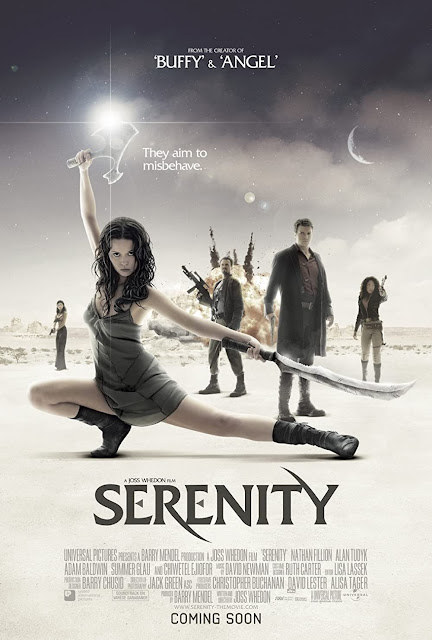
The DVD was called Serenity


And on the Third Year did Firefly arise from death. Truly it is The Messiah of Television shows. 


My first outing with Serenity didn't go quite according to plan. It was during my birthday party that year, and while promising my friends were completely thrown off by its nested opening sequences. I actually was too, but I was prepared to press on. However I was distinctly in the minority, so we settled on a different DVD to watch instead. The next day however, free from the burden of democracy, I gave Serenity another watch. Once again I was somewhat baffled by the opening, but I was also just entering adolescence so I was strangely intrigued by the funny feelings I was getting from watching Summer Glau on screen (they shared a lot of similarities with the funny feelings I got from Lts. Zofia and Eva whenever I played through Red Alert 2 at that time), and that was enough to get me through to where the film proper began. 


Which I am very glad of, because it was GLORIOUS


It quickly rocketed to my number 1 favourite movie slot, and remained there until I discovered that there was in fact an entire TV series of these characters in this setting before it.I managed to borrow a copy of this show, called Firefly, from one of my parents' friends, and was hooked from the start. Now is, however, not the time to delve too deeply into the unforgettable characters and their fantastic dialogue and electric chemistry, or the moments that made me feel things in my very core, or even the profound impact it had on me as my life took a screaming nose dive into hell from which it still hasn't quite recovered, but suffice to say that Firefly helped me through some very hard times. Indeed, it was one of the biggest pillars keeping me going until I discovered symphonic metal and figured out how to make friends again. 


So earlier this year when I happened to be going through some similarly dark stuff at the same time as I was - by an astonishing coincidence - house-sitting for those same people who had kindly lent their DVD set of the show, I decided to take the opportunity to give the whole series a watch-through once more, which I hadn't been able to do in a while because many of the discs in my own box set have since lost their minds. Once again, it helped me through and reminded me that there is still beauty in the world (and in the case of a couple of episodes, that there is ugliness in the world beyond myself). Naturally one of the first things I did upon returning home was then load up my DVD of Serenity - which still works - and complete the story. 


Only, that was where the problems began. That was when the colour began to fade. 


Now don't get me wrong here. I can still recognise that Serenity is a brilliant film and great in its own right, and in all honesty is probably about the best conclusion to the show that we could have realistically got. But... it's just not quite the same as Firefly. Watching it again right next to the series, I couldn't help but feel like... something was missing. 


Sure, it was bigger than Firefly, glossier, with slicker production values, and the movie-scale budget meant it could pack in a few giant flashy centrepieces that would not have been possible with a 2000s TV budget. Sure, it has all of the same ingredients as Firefly. And yet... something felt off about it. It's darker than the TV show, both literally in its visual aesthetics as well as in its overall atmosphere. The characters were always a little dysfunctional in the show, but here they fight more often than give friendly hugs and pats on the back, and they actually fight more than the bickering they did in the show, and I just did not feel like these were the same spaceship crew that would laugh endlessly together about all kinds of silly stuff. They did that all the time on the show - often about something that got brought up off-screen - but I don't remember them doing it once in the movie. Hell, I'm not sure I even remember them laughing much at all in the movie. Even the soundtrack is darker and deeper, more theatrical and less space western for the most part. And, most of all, the movie just seems to be missing that same overall innocence, feeling of love and sense of good honest FUN that the show had (the exceptions of course being the first caper at the start of the film and almost every scene with Mr Universe in it. I suspect it's no coincidence that those parts also tend to stick in the public conscious most). 


Again, I understand that a lot of that isn't really the movie's fault. A lot of it is almost certainly just the inevitable collateral damage that comes from squeezing one or two 22 hour TV seasons' worth of content, including character and storyline development, into just one 2.5 hour feature film. There was always going to be stuff that was lost in that translation. Like I say, I'm aware that the movie is probably the best conclusion anyone could have realistically expected. But that doesn't change the difference in look and feel between the movie and the show, which only grows starker when you watch them back to back. 


And that, then, is where this finally relates to the Tau in Warhammer 40,000. Because it was in thinking on this and reaching these conclusions that I finally at long last understood my issues with Codex: Tau Empire. 


In the Grim Darkness of the Far Future, there is only BROWN!


Codex: Tau Empire was originally released in April 2006, about five years after the original Tau release and two years into 4th edition in what turned out to be the mid-point of the editions period of GW support. It was in most respects a pretty conservative book, especially by later GW standards - most of the army rules were left unchanged from Codex: Tau, with the few things that were changed being largely small but significant. It was accompanied by a somewhat more ambitious lineup of model releases that were centred around importing two Forgeworld vehicle kits - specifically the Skyray SAM TELAR and Piranha patrol speeder - into mainstream 40k plastic form. 


The best feature of the book by far is the expanded armoury section. Andy Hoare and the rest of the writing team on this project took the opportunity in this codex to expand the wargear armoury lineup of Codex Tau - which in fairness is... spartan to say the least - especially the Battlesuit Wargear section, which affords Tau characters with a similar level of options to what armies like Witchhunters have already been enjoying. Indeed, between the new wargear options and the Battlesuit equipment system already in place, Tau characters in Crisis Suits can start to rival even 3.5 Chaos Space Marine characters in their complexity and wealth of options. And with a very generous points budget of 100 for every character, and the most expensive item being 30 points, it is possible to load down a single Crisis Suit with every single item in the entire Battlesuit Wargear list - provided, of course, you did not take Shield Drones to escort them. They'd push you just over the limit, so you'd have to give up something for them. 


You couldn't do it for every Tau character in a Crisis suit though, because almost all of these new Wargear items were tagged with a new rule for this codex - Special Issue. The Special Issue items here mark the start of the tradition of new Tau books introducing brand new cutting edge prototype technology that you could equip certain units - usually characters in Battlesuits - with, and means that any item listed as Special Issue is restricted to one for the whole army. This effectively leaves you with the choice of either piling all the Special Issue stuff onto one single Super Prototype suit, or distributing it around the various Battlesuit characters in the army like a boring person. 


Most of these new Special Issue items were largely fun extras, like the Ejection System or the Failsafe Detonator, while a couple - namely the 2+ Armour Save Irridium Armour and the wound-canceling Stimulant Injector - were very potent and quickly became very popular amongst Tau players. But the crowning jewels of the Special Issue addons weren't Wargear items - they were the two new Battlesuit Support System options included in this book, the Command and Control Node and the Positional Relay. 


Of all the things in this book, the Command and Control Node and the Positional Relay are the two things I miss most about it these days, and the two things I would most strongly consider salvaging from it. Right off the bat they have two very powerful abilities - letting nearby units use the character's leadership for Target Priority tests and getting a single Reserve unit onto the table on a 2+ dice roll regardless of what turn it is, respectively. But more than that, when put on a Shas'El or Shas'O commander they really emphasise their role as leaders and highlight their ability to, well, command things, making them actual command units instead of just fighters with really hardcore stats. Not only that, but they also highlight two different levels of military command - the Command and Control Node, with its effects on on-table local fire control, emphasises command and leadership at the Tactical level, while the Positional Relay with its control over key Reserve deployment reflects command and leadership at the Operational level. It's beautiful. 


The final Special Issue items of note are two new Battlesuit weapon options, the Cyclic Ion Blaster and the Airbursting Fragmentation Projector, both of which got modeled as metal components that are exceptionally cool looking even now. The Airbursting Fragmentation Projector in particular is the best addition from this codex next to the aforementioned support systems, and is an auto-include on my commander in every game not played using Codex: Tau (a rare thing, and getting rarer as time goes on), being essentially a self-guiding cluster bomb launcher that functions as a short-range Mortar on crack. 


In addition to all this, the codex features a new kind of alien auxiliary unit in the form of the Vespid, a new heavy weapons unit in the Sniper Drone team, some expanded options for Stealthsuit teams, a smattering of minor rules alterations here and there, and two new named Special Characters. The first of these is Aun'Va, billed as the head Ethereal that all the other Ethereals in the Tau Empire answer to. In later books his character was taken to some pretty absurd places in the name of pandering to rabid anti-Tau fans (we'll be back for them), but here he's presented how he should have always been as the sagely non-combat Leader type that's a staple of so many RTS escort missions, and while the initial seeds of the later takes are plainly there, its a refreshing image from before the GW writers went Full Putin with him. The second is Commander Shadowsun, conceived as a foil for Farsight, and is essentially a Tau version of Sarah Kerrigan from Starcraft - even right down to the red topknot, thanks to the 'Evy Metal team - something only reinforced by some honestly pretty badass illustration artwork of her out on a covert mission in the middle of a moonlit wilderness. Shadowsun also debuts the XV-22 Battlesuit so beloved of later Tau players, even though I still think it's one of the uglier battlesuit designs; it's the helmet that kills it for me, something that I was very grateful to the Relic team for fixing in the Tau campaign of Dark Crusade


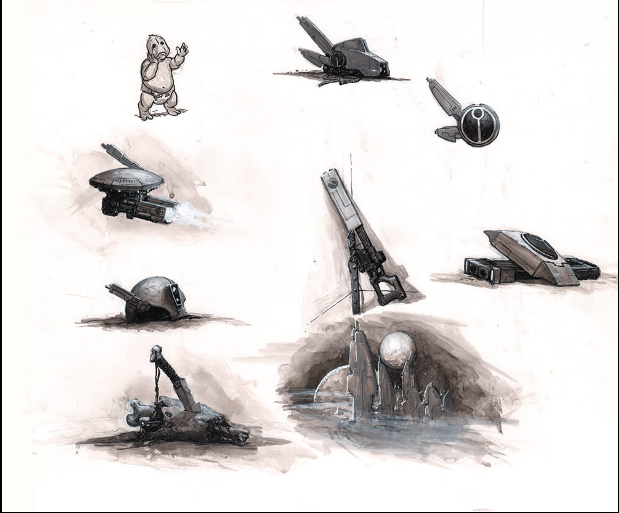
Also, speaking of artwork, Codex: Tau Empire features some more artwork by the legendary Karl Kopinski, in whose breathtaking illustrations Warhammer 40k came of age, and who has easily done the best job of capturing the Warhammer 40,000 universe in visual form (fight me 2nd Edition grognards). Currently featured on the gallery section of Karl Kopinski's website is this spicy little collection of little page doodads. 


Image sourced from KarlKopinski.com. All credit for artwork goes to Karl Kopinski. Seriously, check out all his artwork, he's really good!


Right away it's pretty easy to spot the influence of the Lord Of The Rings Strategy Battle Game page doodads creeping into the visual style, particularly in the shading techniques. But what I find really interesting about this collection is that not all of these made it to the final codex. Not counting the baby doodle (which judging by the very different visual tone was never seriously intended for codex publication), only half of the doodad pieces featured here were featured in the final published book. The ones that GW elected not to use are interesting, because I actually like some of them a little more than some of the final choices. Particular standouts to me include the cityscape at night and the hunk of meat with a knife plunged in it, which would have been a nice bone to throw for the Kroot aspect of the book (pun intended). 


But while Codex: Tau Empire has some fun features, it also harbours some big problems, and indeed carries the seeds of many of the later problems that would surface in GW's direction of the Tau, as well as a couple that would reflect greater problems in GW's direction of 40k itself. To start with, not all of the rules changes were good ones, with many of them being well-meaning but ultimately problematic. Take Flechette Dischargers for instance, easily one of my favourite Tau vehicle upgrade options. This book changed them from being an offensive tool, granting a bit of insurance against Death Or Glory counter-attacks when plowing the vehicle into infantry units, into a defensive tool that inflicts a bunch of moderate strength hits on infantry attacking the vehicle in close combat. Which is.. it's fine from a purely mathematical point of view, but it completely misses the point of what makes Flechette Dischargers so special and important in Codex: Tau - namely that by allowing Tau vehicles to (mostly) Tank Shock infantry units in safety, they provide Tau armies with an alternative to Kroot for clearing opposing troops off of objectives and important locations, which in turn makes the option of a pure Tau army with no alien auxiliaries in it more viable (while at the same time leaving Kroot a relevant option because they can still handle the counter-assault niche better and are better at digging opposing troops out of REALLY dense areas). 


But it goes deeper than that, because the big problem with a lot of the rules changes in Codex: Tau Empire, especially with the existing wargear upgrades, is that they were changed in ways that sacrificed something really fun and special in the name of supporting bog-standardised Pitched Battle Pick Up Games and Tournaments. The Battlesuit Sensor rules and Sensor Spines vehicle upgrade are both good examples of this - in Codex: Tau they give all Battlesuit units and any vehicle with Sensor Spines the equivalent of an Auspex/Scanner for the purposes of detecting Ambushes in Jungle scenarios and Lictor Secret Deployment. The Sensor Spines also give a bonus to navigating minefields. But in this book they give all Battlesuits the Acute Senses special rule, and vehicles the ability to make use of cover as if they weren't skimmers, respectively. 

Which is... again, I get that those effects are both more universally useful, and in particular more relevant to bog standardised Pitched Battle Pick Up Games and Tournaments, so it's great if you're the sort that mostly does that anyway, but it feels soulless. It misses out on something special. The fact that those fun special scenario and environment rules are so fundamentally baked into the DNA of its scenario mechanics is one of the best things about 3.5 Edition Warhammer 40,000, and even one of the very few parts of that core rule set I enjoy more than 4th Edition Warhammer 40,000, and the fact that here we are, with a whole unit special rule and standard vehicle upgrade right there making direct reference to those, that's something I really love. So I don't feel right seeing it gutted and replaced with.. a Universal Special Rule and a generic movement gimmick. 


(as an aside, it's also why the special Daemon World rules in White Dwarf #313(AU) are one of the best things about 4th Edition Warhammer 40,000) 

And of course there's the Markerlights. Codex: Tau Empire marked the beginning of Markerlights being Flanderised by GW writers from being a fun interesting little side quirk of the army into a crutch that's integral for the army to function at all. See, in Codex: Tau, Markerlights are very much a supplemental thing, a little bit of sauce on the side. They are by no means an integral must-have thing, and not only is it entirely possible and very common to build a fully viable Tau army without a single Markerlight in it, that's actually what Games Workshop writer Pete Haines did in the very first inaugural White Dwarf battle report featuring the Tau, and he won that game. Point is, Markerlights in Codex: Tau are a cherry on top that's there to help your assault and heavy weapons hit That One Big Threat That Has To Die Right Now. The trick here, is the magic of the Ballistic Skill 3 stat. Because Ballistic Skill 3 means always hitting on a 4+ with every gun, every shooting attack has a flat 50/50 chance of hitting, which is very easy to plan around. But on top of that, every major Tau weapon carrier has an organic way of improving those odds. Vehicles can take Targeting Arrays to make them Ballistic Skill 4, Battlesuits can take twin-linked guns (and Broadsides in particular even have their guns conveniently already twin-linked to give the player a hint about this), and everything else can effectively throw out so many shooting dice that you're guaranteed to get enough through regardless. 

In that context, Markerlights are not at all essential to a successful Tau army. But in Codex: Tau Empire that all changes. In this book, instead of just making guns hit on a flat 2+ or guiding in Seeker Missiles on a flat 2+, Markerlights provide a range of shooting related bonuses that include ignoring Night Fighting, ignoring Target Priority, improving Pinning chances and, most crucially, ignoring cover saves for the first time. On top of that, this book marks the first place where two of the most widely-used and powerful Markerlight abilities - better shooting accuracy and ignoring cover saves - are stacking modifiers that are very moderate individually, but get exponentially better the more of them are combined. This makes Markerlights enough of a force multiplier as to distinguish Tau armies into "Have Markerlights" and "Have Not Markerlights". Consequently many many more Tau players began including lots of Markerlights (helped by the introduction of a new Markerlight carrying Drone option), which in turn encouraged Games Workshop to double down on their significance in following rule sets, in a vicious cycle that continues to this day. 

Mere rules changes are one thing though, but altogether worse was the shifts in aesthetics and lore. There are many small examples of this scattered throughout the book, but perhaps the biggest one is what happened to the Ethereals, which is emblematic of one of the worst design decisions that GW went with for the post-2004 Tau. 

You see, looking at the Tau media and models ever since the release of Codex: Tau Empire, it is very readily apparent that at some undisclosed point between 2001 and 2006, someone at Games Workshop sat down one day, watched Star Wars: The Phantom Menace, and then said to themselves, "YES! This, this right here, THIS is what we need for our new Tau game faction!" 

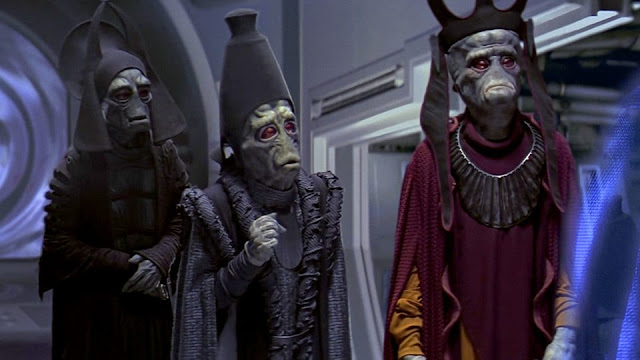
Because since then, with every major iteration, GW seems to be hell-bent on injecting more and more aspects and tropes of the Star Wars Prequel antagonists into the Tau game faction. And the epitome of this trend is the Ethereals, and their models in particular, which each edition seem to get more and more like the Neimoidians in the Star Wars Prequels - especially The Phantom Menace. And it all started with this 2006 Tau release wave, and this Codex: Tau Empire. The Ethereal models released for it represent the most obvious visual links between the two. I mean, just look at them next to each other: 


Real subtle there, GW


I'm using the particular 4th Edition Ethereal sculpt that's closest to those exact costuming designs to illustrate a point. There are about three other variant sculpts that are a little more distinct, but not by a lot. Likewise there was a later plastic Ethereal model released in 2017 which breaks from those characters visually, but this just replaces that with 1) just being a very boring and ugly model in general and 2) only really treating the symptom and not the disease. 

That's because while they started to cut some of the visual ties to the Neimoidians from the Star Wars Prequels, they only doubled down on the characterisation ties. This ones a little hard to explain without lots of video clips, which is a form of techno-sorcery beyond my primitive TV writer brain, but suffice to say that a lot of the major attributes exhibited by the Neimoidian characters - being unscrupulous, greedy, devious and ultimately cowards - are all attributes that are increasingly exhibited by Ethereal characters in post-2005 Tau fiction, both from Games Workshop itself and Black Library. Which is bad not just because it's a very lazy and tired way of characterising authority figures, but also because it's Problematic for the same factors that make the coding and characterisation of the Neimoidian characters in the Star Wars prequels Problematic. A subject on which there's already been plenty of discourse elsewhere. 

In all deadly seriousness, what my creative writer's instincts are telling me happened was that this particular example at least is a case of Convergent Evolution. I suspect that when designing the models, and writing the fiction, the Games Workshop team went to all the same root sources of inspiration that the Phantom Menace production crew did for the Neimoidians, asked all the same questions they did, went through the exact same creative and workshopping processes they did, and thus inevitably came out with an extremely similar end product that has all of the same flaws. 

But then I look at the style of Tau buildings depicted in the themed terrain sets used in all the model shoots (sure, there was a little of the style in the 2001 Games Day board themed around a Tau city, but not with nearly as many weird slim fin-like elements everywhere), and I remember that this 2006 era of the Tau is the same era that produced Dark Crusade, a game that infamously gave Tau drones "Roger Roger" style robot voices, and I cannot help but wonder if someone in Games Workshop circa 2004-2005ish really did watch too many Star Wars prequels. 


But it goes even deeper than that. All throughout the book there's just this creeping darkness, and creeping murkiness, that pervades everything. The new artwork is less bold and vibrant in its shading. The graphics are more sinister. There's the first creeping appearances of the vectors with which Games Workshop will later inject Grim Darkness into the Tau game faction to appease the 1d4chan crowd. In Aun'va's lore blurb they even mention Tau on a crusade for gods sake. Tau! In a crusade! That's the kind of language you'd expect from an Imperial codex, not a Tau one. And all those beautiful 1950s Space Opera throwbacks about exploring the cosmos are thin on the ground, replaced by talk about binary join-or-die expansionism that was never really much of a thing in the earlier material and invariably painted as freak outliers when it did happen. 

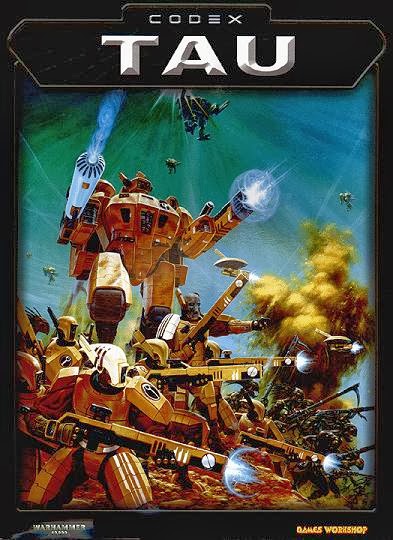
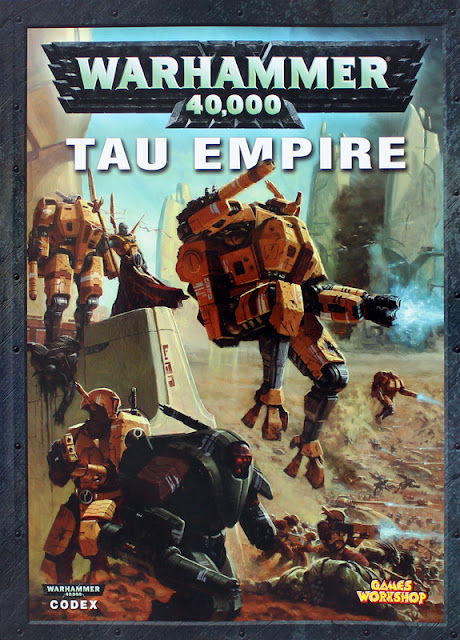
Even the cover illustration is bleaker. Just look at the cover art for Codex: Tau, bursting with bold vibrant colour and life, promising a world of adventure and excitement and dynamic progress: 


Nothing says "Space Opera adventure!" quite like a desert battle beneath an aggressively blue sky


And then compare it to the bleak drab murky tones of the cover art for Codex: Tau Empire


In the Grim Darkness of the far future, there is only BROWN!


And all in all the whole book feels pervaded by, well... a sense of innocence lost. 


Which brings us full circle to the conclusion I've reached, the voice I've finally been able to give to my reservations about this book. You see... 


Codex: Tau Empire is to Codex: Tau what Serenity is to Firefly. 


Sure, it's bigger than Codex: Tau, and glossier, with slicker production values, and the 2006 GW budget meant it could pack in a few giant flashy centrepieces that would not have been possible with a 2001 codex budget. 


And sure, it has all of the same ingredients as Codex: Tau. And yet... something feels off about it. It's darker than the original codex, both literally in its visual aesthetics as well as in its overall atmosphere. The characters were always a little expansionist in the first codex, but here they fight more often than explore the wonders of the cosmos, and they actually fight wars more than the border disputes and peaceful coexistence they practiced in the original lore, and I just do not feel like this is the same love letter to Supermarionation and 1950s - 1970s Space Opera that would solve problems with intelligence more than violence. They did that all the time in the original fiction - often running rings around some hapless human diplomat from the Imperium - but I don't remember them doing it once in Codex: Tau Empire. Hell, I'm not sure I even remember the Imperium sending diplomats to negotiate with the Tau at all in the post-2005 material. Even the cover artwork is darker and deeper, more gritty and less space opera for the most part. And, most of all, Codex: Tau Empire just seems to be missing that same overall innocence, feeling of love and sense of good honest FUN that Codex: Tau has (the exceptions of course being the Wargear Armoury and Special Issue Weapons. I suspect it's no coincidence that those parts also tend to stick in the public conscious most). 


And I'm aware it's not the book's fault. The things that concern me in this book are almost entirely due to flawed creative processes and attempts to pander to the 1d4chan segment of the Warhammer 40,000 player base. But that doesn't change the difference in look and feel between Codex: Tau Empire and Codex: Tau, which only grows starker when you read them back to back. 


It's a reasonable enough book, especially from a purely mechanical point of view, but whenever I look through it I can't help but feel like there's something missing in it, something intangible but very important nonetheless. And it took my first tabletop love from me. 

So that then, is why I invariably give Codex: Tau Empire a pass these days, and use Codex: Tau instead whenever possible, especially in 4th Edition Warhammer 40,000, because that book brings a smile to me more in much the same way that Firefly warms my soul more than Serenity these days. 


GW can't take the sky from me...

Friday, 30 June 2017

F.Y.I. (A rebuttal to GW and the Black Library)

Believe it or not, that's actually a metal reference in the title. I haven't really been keeping tally of how many metal related post titles I've used so far, but if one were to turn it into a drinking game I imagine it'd be a great way to erase any sensitive memories.

Anyway, as the uninitiated may have guessed before reading the above statement, this is going to be another wall of words post. The bad news then is no pretty pictures of models with mediocre paint jobs, but the good news is you get an extra post in addition to the scheduled one concerning the latest kinda-adequately painted models.

See, the other day GW posted up an article on their Warhammer Community blog penned by writer and notorious Enemy of The Empire* Phil Kelly on his newest Tau related novel Farsight: Crisis of Faith. You can find it here if you're interested in reading it. I don't know exactly what about it that it was - maybe it was that some of Phil's thoughts echoed my own, or maybe it just happened to be posted at a time when my enthusiasm for 40k is at an all-time low and my anger towards GW is at an all-time record high - but I nonetheless felt compelled to write a response to it. It did certainly trigger a long bout of introspective soul-searching (by which I of course mean a binge of TVtropes articles to reaffirm my stance and back me up. Except to see TVtropes referred to a lot in this post). So here goes another round of fevered rambling.

The first reaction I had (and I'm going through the Phil Kelly post blow by blow, addressing the points I took from it in chronological order) was that they seem to be trying to turn the story of Farsight (a Tau commander who broke ties with the Tau empire and leads his own renegade splinter faction) into the Horus Heresy with Tau. This... doesn't sit well with me. Like, AT ALL. Even without going into my feelings towards the Horus Heresy itself (which range from apathy to hatred that burns with the fury of a thousand suns, depending on how long ago I looked through Forgeworld's model ranges), the idea of taking an entirely unrelated faction and using it to make a clone of the Horus Heresy feels kind of cheap and un-creative to me. The Horus Heresy has already been done, and while opinions on its execution vary, the general consensus seems to be positive. Why do it again if you got it right the first second-third time?

But more than that, the reason this idea feels so wrong to me is that it's essentially turning the Tau into something that they're not, and I don't think were ever really meant to be. And even worse, that's unnecessary. As many fans of 40k will point out to you, the Warhammer 40,000 setting is big. Really big. Even the writers at GW and BL may not always be quite fully aware of just how enormously, mind-bogglingly big the 41st Millennium can be. I mean you might think that the Inner Sphere in Battletech is a big place with lots of worlds of adventure, but that's all just peanuts compared to 40k's setting (not that I'm dismissing Battletech's setting - it might be a little rigid for my tastes but it is still extremely immersive and 'Game of Thrones in space with giant robots' is a guaranteed recipe for awesome - but in terms of sheer scale it really is much smaller).

A lot of those same 40k fans will quickly point out to you that this gigantic setting is great for huge scale stories. But here's the thing: it also means there's lots of room for different stories. As a setting whose basic premise is essentially 'Sci-fi trope deathmatch' (as one TVtropes page so eloquently puts it), there's a faction or entity for every kind of story you could conceivably want to write. You've got Space Marines for action pulp, the Imperial Guard for gritty war stories, the Inquisition for gritty investigative Noir and cosmic horror, and those are just from the Imperium. Want to write a grand sweeping Space Fantasy? The Eldar are a perfect fit. Feel like making a Black Comedy? Da Orks have got you covered. Want to explore the darkest parts of human nature? Chaos has it on lock.

The thing to take away here is that there is absolutely no reason why you need to recycle stories across factions in the setting. Each one has a unique narrative niche to fill.

And the Tau are no exception.

I'd invite you to travel back in time to the early 2000s with me, but if you're familiar at all with this blog then you'll already know that I have unleashed all manner of dark and unspeakable forbidden powers to shatter the fabric of Space-Time so that it is perpetually in early 2000s stasis on here and the year never moves past 2008 unless I will it (though I also make an exception for Delain's post-We Are The Others albums. The Human Contradiction and Moonbathers are both kickass). So instead I will direct your attention to the period of 1999 - 2002ish. As a child, I never really grew up with Anime or Manga, unlike what seems to be just about every other Tau enthusiast in existence. Most of it was always just out of reach for me, so it remained one of those periphery things that I caught bits and bobs about here and there, but never really had any full exposure to (Dragon Ball Z and Pokemon were two notable exceptions, but I feel like their long-term influence on me has been negligible).

Instead, I grew up on a steady diet of classic 20th century Space Opera. While I did start powering through Dune books from age 11 onwards, for most of my childhood the actual content of most 20th century space operas was beyond the comprehension of my primitive kid brain (and certainly well outside its limited attention span), so I was mostly left looking at the phenomenal artwork that accompanied those stories, fantastical paintings of all kinds of spaceships and robots and laser cannons and time machines and other science fiction goodness. And oh boy was that a lasting influence. I can see with hindsight that my love of classic 20th century Space Opera was and remains a big factor in my fondness for the Tau, but with the advantage of age and accumulated wisdom I'm also able to put two and two together. The Tau, in their original 3rd edition depiction at least**, are effectively a love-letter to that 20th century Space Opera. And that is the kind of stories they're there for - those bright shining tales of adventure in the cosmos, solving mysteries and puzzles with science and technology, and embodying the ideals of the Enlightenment movement (and this is coming from someone who's a die-hard Romantic) to lead the universe into a better tomorrow. Y'know, after a whole bunch of conflict. Gotta have meaningful conflict for drama.

Thus, injecting this whole "Epic tale" that "Splits the T'au (sic)*** Empire down the middle" just feels to me like forcing a square peg into a round hole. If you want to write epic tales of betrayal and brother against brother (and who hasn't) then why not write about the actual Horus Heresy? Or another Imperial tale of betrayal?

Before I go on, I feel like I should clarify exactly what I'm talking about here. I don't mean to say that you can't make the Tau epic. Hell, plenty of those 20th Century Space Operas were epic as Epica. but I posit that there's epic and there's epic. What I mean when I say "making an 'Epic Tale' about the Tau is the wrong way to go" is using the same flavour of epic that's used in the Horus Heresy books, or late 8th edition and ET background, or the thrice-damned AOS. The kind of thing where big heroic heroes sweep in and win the day after impossible odds that would have felled ye mortal regulars many times over, but not our heroic heroes, who face off in a clash of blades and then pose proudly on the cover splash. That's certainly a gross oversimplification, one might almost call it a Strawman, but it's the recurring pattern I keep seeing over and over and over in what I've started to dub 'NuGW' and the stories it produces.

What I'm trying to say, I think, is that these statements have me concerned that they're trying to give the Tau a Horus Heresy, and I just don't see the point in that and indeed it sort of misses the point in where the Tau's real strength lies from a storytelling perspective.

Now, at the same time this touches on another issue. I've had some discussions on Advanced Tau Tactica before about bringing the Tau into the wider 40k setting. The debate here is between keeping the Tau confined to a small corner of the 41st Millennium and never really impacting on the wider setting, and bringing them into the wider setting and having them interact more with the status quo. Personally, I'm inclined towards the latter, but with specific conditions. At any rate, the crux of the matter in how it relates to Phil's article is thus; it's all well and good to try and get the Tau to play a bigger part in the grand scheme of things, but NOT at the cost of their identity. They still have to stay fundamentally as who they are. Sure, you have a bit of wiggle room for change in the face of new circumstances, but if you get to the point where you're compromising what makes them unique, what makes them the way they are, and getting in the way of where they come from, then something has gone wrong and you should probably ask yourself why the story needs to be about them in the first place.

And it's no co-incidence that I stopped making any references to Tau specifically in the last part of that paragraph, because it applies equally to all 40k factions and groups.

Let's move on shall we? Phil then goes on to make some remarks about the appeal to him in writing about the Tau. On some points, I can actually agree - the contrast between the bright and idealistic Tau and the, well, grim darkness of the rest of 40k is fascinating and fertile ground for creative stories. Some parts seem a little stupid (Space Marines aren't just "a brutal wall of muscle and ceramite" and 'monsters in power armour' to Tau, they're brutal walls of muscle and ceramite and monsters in power armour to everyone. Being a brutal wall of muscle and ceramite and a monster in power armour is literally the entire point of a Space Marine). One point in particular angried up my blood no end, but I'll save that for later. As Spider Jerusalem said to an irritating toll booth operator, "I'll be back for you".

It is this point here, however where we get to the real meat of my thoughts about all this. To quote directly from the article:

"How the T’au’s firepower and newly minted confidence fares against the ancient, the malevolent and the supernatural is a real draw for me. There’s a great contrast between elegant tech and gribbly horror, and the fact that in the darkness of that gothic universe, logic and science can be a limitation, or worse, a liability. 

You know the awful truth, of course. Hopefully you will be thinking ‘run, you fools!’ whenever the T’au, wide-eyed, walk straight into the lair of a menace they know nothing about – or bite off more than they can chew, and have to fight their way back out. The real threat to T’au society, however, is the truths they uncover as they do so."
This part here I found particularly intriguing, because I've actually been thinking much the same thing recently. There is a lot of potential in the interactions the Tau have with some of the more, as Phil puts it, "Gribbly horror" of the 40k setting. However, the really interesting part is that the conclusion I've come to could not be further from his. My own take is essentially the total opposite - that a bit of science and reason and a whole lot of high-tech firepower is just the thing that's needed for the darkness of that gothic universe, and that logic and science can be a strength, or better, the answer. 

In other words, while they're busy trying to write Supernatural, I'm busy writing Ghostbusters****. 


Upon reflection I suspect a large part of this drive comes from my time playing Diablo III, which introduced me to the simple animalistic joys of shooting demons in the face with crossbows. However, it also introduced me to the radical subversive idea of shooting immortal hell-gods in the face with crossbows. And it taught me that nothing, NOTHING is truly unstoppable. ANYTHING, whether its a giant monster or an immortal eldritch super-organism from the dawn of time, WILL go down if you hit it enough times. 

No exceptions. 

None. 

Now, that's not to say it should be easy to bring down immortal god-like entities, or that it should happen all the time. That way lies madness and Eldar Avatars in the 5th edition background. Likewise, if a random extra does it, it's going to be rather anti-climatic. But when it's done by well-written character that you care about, and done in a clever way that requires all of said character's skill and cunning, then you can get some phenomenally badass moments. One of the many, many, many moments in Buffy The Vampire Slayer that I really love comes in Season 2, after the villains have succeeded in unleashing a supposedly nigh-unstoppable monster upon the world. Said monster begins to rampage unchecked through a shopping mall, utterly confident in its indestructibility, until it turns around... 


... to face Sarah Michelle Gellar with a rocket launcher. 


What follows is about what you'd expect, and it's brilliant for subverting the standard conventions of those kinds of things being immune to humans. It's for similar reasons that I've always liked that moment in Return of The King then the Witch King confidently states that no man can kill it, only for Eowyn to throw off her helmet, point out that she isn't a man, and then stab said Nazghul in the face with a sword. My point is that while it's very fun to write grim nihilistic Cosmic Horror stories where the eldritch abominations can't be stopped and we're all just helpless playthings, it can also be just as fun when it turns out that the helpless mortals turn out to be not so helpless after all and bring the monster down in the end. Either approach can get tiring if it's overdone, and ideally you want a good balance of both. Sometimes Cuthulu just regenerates after having a boat driven through its head, and there's nothing anyone can really do about it, but sometimes shooting the immortal star god in the face with a railgun actually works. It's variety that's the key. 

That's why when I get writing some more feature length Tau stories, ideally you'll be thinking "Badass!" when they finally manage to bring down the rampaging horror. Sometimes at least. 

Now if you're a follower of the 1D4chan crowd or it's ilk (and if any of them are actually reading this, I will be a mixture of surprised, honoured and disturbed), you'll probably be in a state of shock if you've managed to get this far. After all, Tau of all things being what finally brings down the big bads of 40k must be fairly close to the ultimate heresy. That just wouldn't do at all for something that's supposed to be the epitome of grimdark. Which brings me nicely to the other big thing that's been eating me. You remember that point I mentioned above that had me seething with barely-contained RAGE that I said we'd get back to? It's time to address it. 

It's the continuing trend of trying to artificially darken the Tau. I cannot stress how much I HATE that idea. Because it totally defeats the point of the Tau. And don't tell me that that's a subjective stance, I have official word to back me up on that. In the original Designer's Notes on the Tau, published in White Dwarf #262 (US), Andy Chambers himself wrote as much: 

"In contrast to other races, we wanted the Tau to be altruistic and idealistic, believing heartily in unification as the way forward." 

That line was ripped straight from the text. That is how the Tau should be, and to take that away is sort of missing the point of them. If you want grim darkness, then there are seven other factions you can get it in (more if you count sub-groups), you really don't need another. And here's the other thing. I'm going to let you in on a little secret, known to only a few. Here it is. 

You can have groups that aren't dark in a dark setting WITHOUT taking away its darkness. 

It's true, believe me. It is possible to have it both ways. You can have your genuinely bright altruistic good guy Tau, and if they're the only group like that in the setting, then it will still be grim and dark. In fact, when you think about it, the idea of the Tau being just as dark as everyone else really is actually pretty boring. If you take away that shiny altruism, then what's left that really makes the Tau unique? Battlesuits? Yawn. 

At that point they really just become a palette-swapped Imperium. And if you get to that point then why not just write about the Imperium? 

There's a quote on the TVtropes page for the Marvel comic book character Squirrel Girl. It's uncredited, but here is how it goes: 

"Maybe it's just me, but I'm not crazy about super hero stories where everything's all dark and moody. Personally, I like the ones where good guys fight giant apes on the moon and stuff. Remember those? I do. That was back when comic book worlds were places you wanted to escape to... not from." 

This basically sums up my stance towards 40k. Maybe it's just me, but when I'm confronted with a 40k that's grim and cynical and utterly dark without any redeeming groups whatsoever (and the Ultramarines don't count), I immediately get Darkness Induced Audience Apathy and can only ask "Why do I care about any of this?" And the answer is, inevitably, "I don't care about any of this" which is never the reaction you want to get from a story. 

And I get it. I totally understand the appeal of a grim dark setting. Truth be told I'm actually pretty grimdark myself. And I definitely don't want to see 40k get too light and have too many good guys either - that's one of my biggest criticisms about NuGW background lore after, well, it's existence. But I posit to you that it is possible to have a happy medium between the two extremes. 

So it's totally OK to have grim dark stories in a grim dark 40k setting, but please leave the blue-blooded 20th Century Space Opera homage that is the Tau out of it. Leave them for us folk who want to write about the good guys and get a warm fuzzy feeling whenever they win games. 

And if you're concerned about how non-red blood looks in artwork, then go back to black and white monochrome artwork. It looks much better anyway. 


*That's a little Advanced Tau Tactica humour in case you didn't know.
**Still the only one that matters - with one or two exceptions any background about them written since then is Fake News(TM) and should be dismissed as the heresy it is. 
***Though I feel like I'm the only person in the universe who does, I still maintain that the injection of an apostrophe into the name 'Tau' is stupid. I know T'au is the Tau homeworld, but that's like calling all Russians Muscovites. There's more to Russia than just Moscow and there's more Septs in the Tau Empire than T'au. 
****The first one, just before anyone starts jumping to conclusions. While I personally didn't find the reboot that bad, I understand it's very much cinematic Marmite.